Showing posts with label birds. Show all posts

Friday, May 12, 2017

Eagles and Vultures


On January 1st I wrote a short poem which included this repeating line;-

“Whatever this year may bring I will remember…"

After I wrote it I almost hesitated to complete the post thinking I was tempting fate. But I am not overly superstitious and now recognize those words have grounded me over a few months of turmoil and change. Not that anything completely devastating has happened, but like Solomon wrote, it is often small things growing out of proportion that bring conflict and misunderstanding in our relationships.

Catch all the foxes, those little foxes, 
before they ruin the vineyard of love, 
for the grapevines are blossoming!  

Song of Solomon 2:15


I had a few days off work this week and the beauty of the beginning of May has restored and uplifted my spirit. I ventured out to the Nith River, which is flooded and fast-flowing due to recent heavy and frequent rain storms. The Bald Eagles are parents once again and appear to be raising one eaglet this season. They rule their world from the top of a lone pine tree and soar majestically in the sky, taking turns watching their offspring.


A little further down the road I came across a dilapidated shed where seven turkey vultures rested, opening their wings at times to the sunshine. They are similar in size to the Bald Eagles and are graceful in flight. But the differences between the birds are striking.

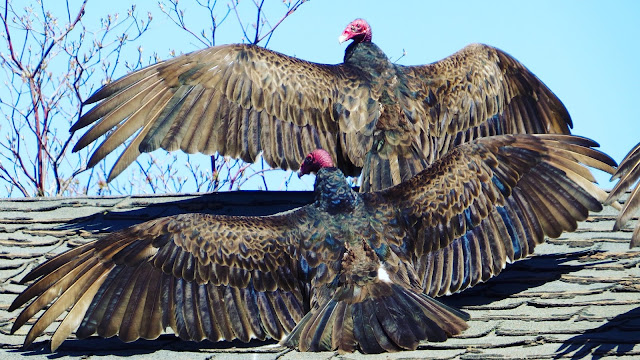
  • Bald Eagles build a large nest high in a tree or cliff. Turkey Vultures do not build nests but lay eggs in caves, crevices, or abandoned buildings.
  • Eagles have talons for catching live prey while Vultures have no need of talons or strong feet for their diet of carrion.
  • Vultures are communal by nature and hang out in groups. Bald Eagles sometimes roost communally in the winter near a food source but are solitary and territorial most of the year.
  • Turkey Vultures have a well developed sense of smell for sourcing food while Bald Eagles rely more on keen eyesight for hunting.
  • Vultures lack a syrinx, the vocal organ of birds. They vocalize only with hisses and grunts. The Bald Eagle has a audible call that echoes across the river. Even the young eaglet can emit a loud, repeated single note when it is alone the nest.
  • And then there is the head… a majestic, white-feathered head with piercing yellow eyes compared to a homely bald, red head with large olfactory openings.
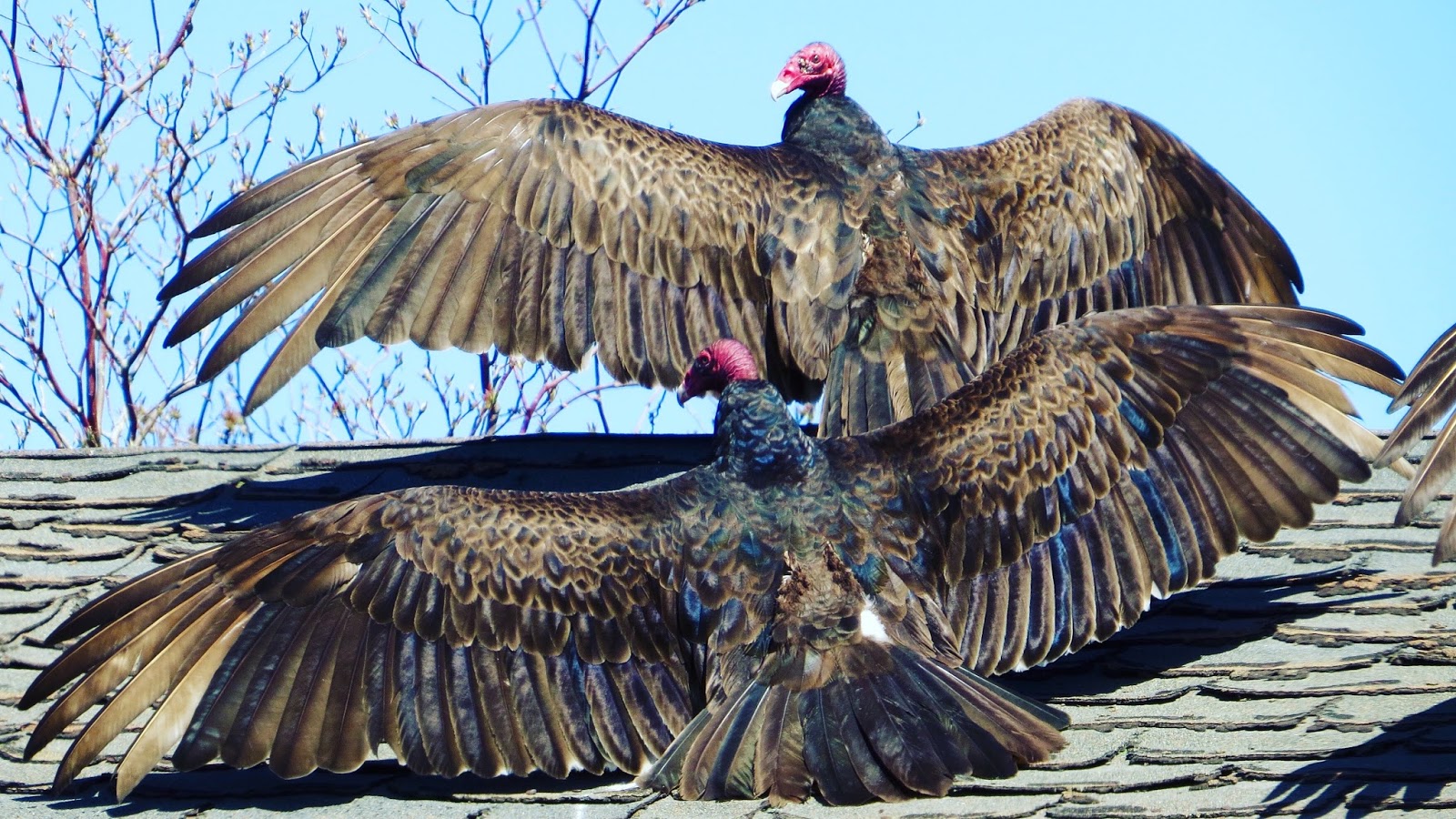

The diversity of the natural world is not divisive but complementary. Eagles and Vultures each have important roles and one is not more valuable than the other. There are times when dead things need to be cleaned up.

Recently, I took a patient for a walk with a coworker. We chatted about the weather and looked out the window at the opening leaves and flowers. I cleaned the patient’s glasses and combed their hair. The person sat down after the walk and while we watched, died instantly. There was no warning, no cry, no pain, just sudden death. It made me glad that the last 15 minutes of life was spent in an agreeable way. If there was unresolved conflict in that life, there was no opportunity for resolution.

Can you find the single eaglet in the bottom left side of the nest?

We would choose to soar like eagles, living territorially above the grittiness of earth. But there are times when we must deal with conflict and death, putting our heads into the carcass of the past or present before moving ahead to better things.


Currently reading: Water to Wine by Brian Zahnd
Currently listening to: Illumination: Peaceful Gregorian Chants

Sunday, January 15, 2017

Deep Winter


Northern Cardinal (m)

Winter arrived suddenly after a hot summer and long autumn season. We have received a lot of lake effect snow from the relatively warm, open waters of Lake Huron along with days of dreaded "mixed precipitation". Just before Christmas I bought snow tires for my 4 wheel drive vehicle and I have been thankful for them several times in the past month. I also bought "snow tires" for my feet in the form of vibram-soled Sperry winter boots. I prefer driving on ice to walking on ice and the new boots have eased a lot of anxiety about falling. (Here is a link to an Ontario study about the best winter boots for staying upright) 

There has been little time for birding and trail walking this month but I have been out on a couple of occasions. American Tree Sparrows, with their bi-coloured beaks and distinctive chest spot look for handouts along with Juncos, Chickadees and Nuthatches.

American Tree Sparrow (banded)


The river is home to "snowbirds" from the near and far north. Bufflehead ducks, Goldeneyes, Mergansers of all types, and other small diving ducks fish in fast-flowing open waters of the Grand River. I haven't made it down to Lake Ontario yet this winter where many other water birds over-winter.

Bufflehead (m) Duck

One afternoon I heard a lot of anxious bird chatter and looked up to see this Cooper's Hawk patiently waiting for his next meal, or, perhaps he was just sunning at the top of the tree. No songbird would dare fly in close proximity to this swift hunter.


The same day, we found a couple of American Robins in our neighbourhood digging in the dirt close to houses where the snow had receded. I usually see a few Robins in January but they are often by the river in berry thickets. 


The pictures below were taken last week. The first was after a beautiful snowfall and the second was taken the next morning as people were rushing to work. Our region has built multiple roundabouts to replace traditional intersections. I have mixed feelings about them as some people are still confused about how to navigate multi-lane versions. The car in the picture left the road at a roundabout near our home, accelerated up a sloped yard right into the townhouse. It took a day to extract the vehicle because of the structural damage to the building. I don't mind winter driving myself, but I am wary of other people who are not comfortable driving on ice and snow.


In spite of winter hazards, there is still time for fun. Our dog loves to chase a sled down the nearby slopes of the old city dump, affectionately known as Mount Trashmore. We are expecting a January thaw this week but hopefully it is short-lived so winter sport venues can enjoy a profitable season. Winter is not my favourite time of year, but I will make the best of it, especially as I see the days getting longer and pointing to spring.


Monday, August 15, 2016

Butterflies and More

September 2008

I took this picture eight years ago near our house. From 2006 to 2009 we collected monarch caterpillars and looked after them as they went from chrysalis to butterfly. We have milkweed growing in a section of our garden and they used to attract Monarchs, but I have only seen one in our yard in the past two years. Here is a video I took in 2008 showing how the chrysalis is formed.


I search for butterflies as diligently as I look for birds when I am out and about. The pictures below show almost all the butterflies I have seen so far in 2016. We saw a couple of Monarchs flying across the highway when we were on Manitoulin Island in July, but none resting in the ditches and meadows. 

Giant Swallowtail Butterfly                                                                     Tiger Swallowtail Butterfly

This is the first time I have identified a Giant Swallowtail butterfly. We found it at Mud Lake in the city of Ottawa, Ontario this spring. Tiger Swallowtails have visited our garden a couple to times this summer. The one above was on a flowering shrub at Queenston Heights near Niagara Falls, Ontario in July.

           Cabbage Whites                                       Milbert's Tortoiseshell                                      Great Spangled Fritillary

I walked the length of the road at Manitoulin Island every day, taking two to three hours each time to look for birds and butterflies. The weather was hot and there were plenty of wildflowers in bloom. I counted only three species pictured above and saw each of them only once.

Underwing moth species                                                                            12 Spotted Skimmer

There is a slow moving creek that flows into Lake Manitou where we stay. Water lilies and Arrowhead plants grow in the shallow water and most years there are many bullfrogs and dragonflies. I never saw a single dragonfly there this year but finally found one at the edge of Lake Huron when we were waiting to take the ferry home. The Underwing moth was tattered and almost lifeless beside the road.

Black and White Warbler- Manitoulin Island

I observe nature but am not an expert by any stretch. It is obvious that the numbers of butterflies, dragonflies, bees and other pollinators are declining. There are likely many contributing factors, including climate change, habitat loss, insecticide use, to name a few. Many of our birds are insectivorous and are threatened when their food source is reduced. For instance, Barn Swallow numbers have declined 65% since the 1960s due to habitat loss and use of chemical insecticides. The Black and White Warbler above looked down at me one morning when I was birding on Manitoulin Island this summer. Warblers need insects too. 

As I wrote this post on our deck this evening, I was irritated by numerous mosquitoes. It has been a dry summer but our weekend rains brought a new hatch of the annoying insects. It seems that some insects have adapted to change better than others. 

Monday, August 01, 2016

Life Birds and More on Manitoulin Island

Baltimore Oriole (f), E. Bluebird (juv), Fritillary butterfly, Singing Swamp Sparrow

I enjoy birding on Manitoulin Island in the summer as much as my husband enjoys fishing. We have not been there since 2013 as we vacationed in other places the past two years. For eight years or so, we booked the cabin at the beginning of July. Many of the migratory birds were still very territorial as breeding season was beginning. The males were easy to see as they sang loudly from hydro wires, tree tops and open branches, marking their nesting area. This year we went to Lake Manitou the last week of July. I could hardly find any birds the first day or two. There were many young birds around who had fledged but who still needed help finding food. These young birds are very vulnerable to predators and generally stayed hidden in thickets and brush. The adult birds were very secretive too. 

American Bittern

One bird I have searched for unsuccessfully in every marsh is an American Bittern. They have likely seen me, but I have never seen them. This bird stands very still with its head in an upward position in the reeds. Imagine my surprise when I saw one in a MEADOW by a creek behind the cabin. There was not a cattail in sight. I had about 10 seconds to get a blurry shot on my camera before it flew away.

Lincoln's Sparrow or Juvenile Chipping Sparrows? (answer is JCS)

The camp is bounded by a lake, creek, meadows, farmland, dogwood thickets and woodland. The varied habitat attracts a great variety of birds. I counted 74 species this year that I could identify within a one square kilometer area. Juveniles are very confusing so there were some I could not name.

A small sparrow caught my attention more than once. It had a streaked breast but was not a Song Sparrow. It did not have the eye markings of a Savannah Sparrow, nor was it a Swamp Sparrow. It liked to peck along the gravel roadway. (We found a dead one that had been recently hit by a car). I was hoping it was a Lincoln's Sparrow, which does nest in the area, but it was likely a juvenile Chipping Sparrow. Sparrows can be confusing even if they are mature.


Approximately 12 Sandhill Cranes occupied the farm field across the road. They are as persistently noisy as a rooster and made a fuss if we looked at them. Here is a 15 second clip of their call. Unlike roosters, they were quiet until after sunrise.

The eBird app on my phone was very useful while birding and I submitted checklists twice a day. Every week of summer is different for birding. Black birds are already flocking in preparation for migration. I have seen one third of the birds that have been identified on the island so there are a lot more yet to find.

Saturday, May 07, 2016

About Birds, Nests and Caretaking

Male Bobolink in the meadow

One of my favourite places to go birding is a large field in the country that contains five large communication towers. The meadow is fenced and no public access is allowed. It is the only regional place I have found that is home to nesting Bobolinks, Horned Larks, Meadowlarks, Grasshopper Sparrows as well as more commonly found birds like Bluebirds, Savannah Sparrows, Killdeer and Goldfinches. Bobolinks are very hard to find and their overall numbers have decreased 74% since the 1960s mainly because of loss of meadow land. They build their nests on the ground and raise one or two broods a season. I took this picture of a male last May when they returned from wintering in South America.

I visited the area one evening in June and was horrified to see that the field had been mowed. The land had not been touched in the several years I had been coming here. Large round bales of meadow grasses and flowers were scattered about and the lack of bird song created an eerie silence. I took one picture and left quickly, very upset that bird habitat was destroyed during nesting season, just for cattle feed. 

Bobolink meadow mowed and baled

We have a lot of farmland surrounding our city. The main crops are corn and soybeans and mixed farms are scarce except among the Old Order Mennonite community. Corn and soybean fields line the roadways kilometer after kilometer.  Corn crops are mainly used for animal feed, ethanol, and processed corn products. Soybeans are also used for animal feed and processed foods. With all the soybeans grown in the area, I cannot buy a single fresh pod of  fresh edamame anywhere because the entire crop is sold through a marketing board before it is planted.

Corn, corn and more corn across the road from the Bobolink meadow

More than half of the grain crop in North America is used for livestock feed, in other words, for meat and dairy production. Factory farming methods have contributed to ecological destruction in other ways. Single commodity crops require large amounts of fertilizer and pesticides which in turn contaminate water supplies and likely contribute to recent declines in pollinator insects. Animals raised in factory farms are given antibiotics routinely and this adds in part to increasing antibiotic resistance. Cattle produce significant amounts of green house gases (methane) and factory farmed animals produce huge amounts of untreated fecal waste.

In 2006 the United Nations produced a report called Livestock's Long Shadow: Environmental Issues and Options. It claimed, among other things, that livestock create 18% of green house gases which is more than all types of motor vehicles combined. The report is available online or you can read the Wikipedia summary at the link above.

Seven years ago I decided to stop eating meat, mainly for health reasons. I also decreased my dairy intake significantly and the benefits to my well-being were significant. Over time, I continued to abstain from animal products for the good of the environment and for the welfare of the animals themselves. My husband is a meat eater and the dog will not eat vegetables so we have animal products on our grocery list. But our meals are mostly plant based and we try to buy meat and cheese locally, using it sparingly. It is unrealistic to think that the whole world will become vegan but even modest reductions in processed foods and animal products can make a big difference to the environment.

Local Old Order Mennonite farmer harvesting corn on his small mixed farm

I realize our household carbon footprint is still too large. We continue to look for ways to contribute to better environmental and social practices that will make a difference to earth and its inhabitants in future generations. The issues are complex and are different in third world nations than in first world nations. Our demand for inexpensive food, clothing, and other "throw-away" possessions is detrimental to the earth and to the workers in developing nations.

This documentary contains much of the information contained in the 2006 United Nations report on livestock. The first ten minutes or so outline the basic concepts that are discussed.


“Only within the moment of time represented by the present century has one species -- man -- 
acquired significant power to alter the nature of the world. ” 
Rachel Carson, Silent Spring

Monday, April 04, 2016

Background Changes


After a mild winter with little snow, spring has thrown in an ice storm and two significant snowfalls. My husband was watching the bird feeders this weekend and commented on the Dark-eyed Juncos that were hopping on the snow-covered deck searching for seeds dropped by the messy finches. It was the first time he had noticed our winter visitors this season. They have been here since September, but without snow they blend into the branches and ground unlike our more colourful birds. With a white background, they are far more visible. 

Juncos come south in the winter and then vanish to northern nesting grounds when spring is well established. We visited the province of Newfoundland last July and saw nesting Juncos in Gander. Juncos hopped about on the sidewalks of downtown St. John’s just like House Sparrows do in southern Ontario. It was the first time I had seen them in the summertime. 

Personal relationships, careers, locale, retirement, illness, losses, conflict and political events can alter the background colour of our lives. Attitudes and behaviours that were not apparent in the past can stand out in times of transition. People can show admirable strength of character or demonstrate a lack coping skills when faced with background changes.

The age of social media, instant information and misinformation, excessive and often irrational opining, can bring confusion and anxiety. These words, published in 1859, apply today.

“It was the best of times, it was the worst of times, it was the age of wisdom, it was the age of foolishness, it was the epoch of belief, it was the epoch of incredulity, it was the season of Light, it was the season of Darkness, it was the spring of hope, it was the winter of despair, we had everything before us, we had nothing before us, we were all going direct to Heaven, we were all going direct the other way – in short, the period was so far like the present period, that some of its noisiest authorities insisted on its being received, for good or for evil, in the superlative degree of comparison only.”  Charles Dickens, A Tale of Two Cities


My observations of nature reinforce the fact that change is cyclical and essential. The Juncos that are so outstanding today will leave over the next few weeks for their summer home. Seasonal background changes offer opportunity for learning and discovery. 

I am on the cusp of significant change as retirement from a full time career comes closer. It may happen in one year or ten, but it is on the horizon. The timing may be up to me or may be a decision made by others. I feel as uncertain as I did when deciding on a career path after high school. It is time for new goals and new learning on a new background. 

Monday, June 15, 2015

Inspiration from Nature

May is the main month of migration and June is a busy month when many species raise their young. I enjoy watching nature in action and have spent time recently admiring parents in the wild. Many biblical parallels come to mind in the grand cathedral of trees, grass and sky. 


Like an eagle that rouses her chicks and hovers over her young,
so he spread his wings to take them up and carried them safely on his pinions.

Deuteronomy 32:11


The two young eagles will be in the nest for another month or so if they fledge at the same time as last year's eaglet. I have seen an immature eagle soaring above here with the adults and wonder if it is last year's bird.

Song Sparrow
Look at the birds. 
They don't plant or harvest or store food in barns, 
for your heavenly Father feeds them. 
And aren't you far more valuable to him than they are?

Matthew 6:26

Savannah Sparrow
3 

Even the sparrow finds a home, and the swallow builds her nest
 and raises her young at a place near your altar...

Psalm 84:3

Eastern Bluebird

We were driving along the Trans Canada trail near St. Jacobs Ontario and had to turn back because the bridge was flooded due to heavy rains this month. In the field were ewes with lambs birthed just hours before. The young were wobbly on their feet and some were still resting in the grass.


He tends his flock like a shepherd:
He gathers the lambs in his arms
and carries them close to his heart;
he gently leads those that have young

Isaiah 40:11


I was fortunate to find nesting Grebes in this park. I sat comfortably on a bench and watched them care for their young for an hour. What a beautiful family.

He will cover you with his feathers,
and under his wings you will find refuge;
his faithfulness will be your shield and rampart.

Psalm 90:4


Sunday, May 24, 2015

Bird Music


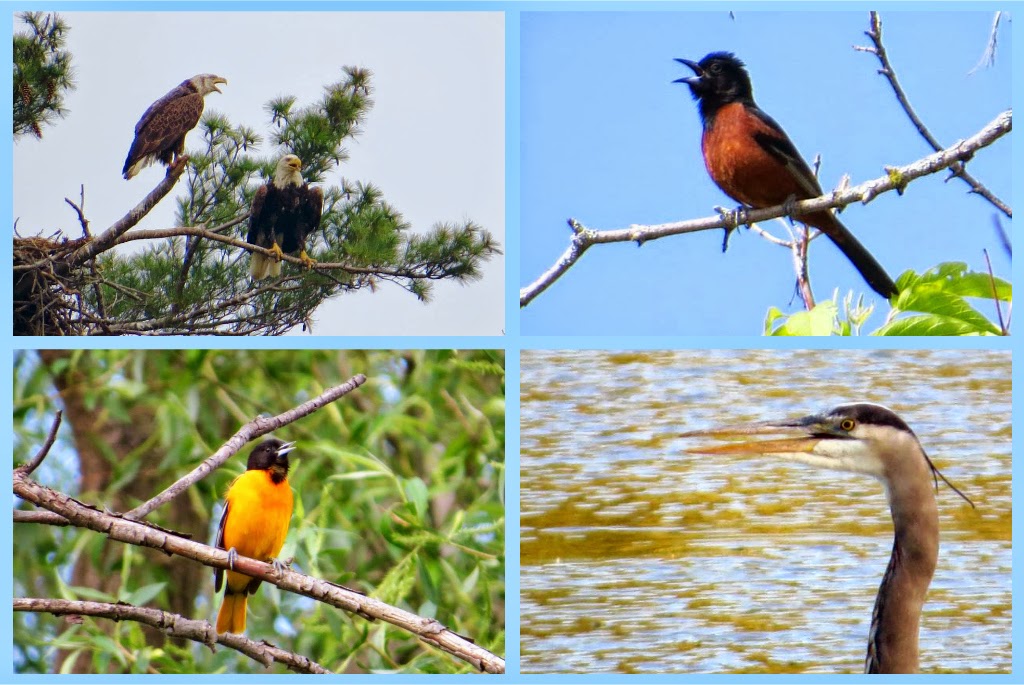
Bald Eagle, Orchard Oriole, Baltimore Oriole, Great Blue Heron

Months of bitter winter cold kept me hostage indoors earlier this year. Spring came late and then rushed by with wide temperature ranges and little rain. Forsythia and lilacs bloomed together in some areas instead of a month apart as usual. Spring birds returned in a trickle and then in a flood over the past two weeks. The forest canopy opened quickly making it hard to see some of our smallest songbirds. But the woods, marshes and meadows are alive with birdsong. I have the songs and calls of all the birds of Eastern North America on my iPod and I listen to them in the car, hoping to become familiar with more of them.

Brown Thrasher, Red-winged Blackbird (2), Norther Flicker

Songbirds learn their species' sounds in the first few days and weeks of life. Occasionally there are regional variations. Some birds have a repertoire of a couple of songs while others may have many more calls and melodies. A few birds like Mockingbirds and parrots are able to imitate sounds they hear from other birds, humans or machines. I visited a patient once who had a parrot who said hello every time the phone rang. Some birds can learn another species' song if they are adopted into that bird's nest shortly after birth. But on the whole, listening is a reliable way to identify many birds. I followed the sound of a Pine Warbler and after fifteen minutes of neck-stretching searching, found it on the top of the tallest pine tree. Birds, especially the males, are often more vocal in the spring as they establish nesting territories and go through mating rituals.

Savannah Sparrow, Rose-breasted Grosbeak, Pine Warbler, Bobolink

Like birds, humans learn language and music beginning in infancy even though words and melody activate different areas of the brain. We know that children can learn other languages without an accent if they are exposed before adulthood. I came to Canada as a school child with a strong South African accent, but it was gone in a few months. Adults hold on to an accent for life. The music styles we are exposed to when we are young tend to become our preferences for life. I do not understand eastern music with its alternate scales and tones and it would be difficult for me to learn it now. Exposure to various music styles at an early age increases our understanding and enjoyment of more genres of music as we get older.

American Goldfinch. Female Red-winged Blackbird, Yellow Warbler

Music is often at the centre of generational separation and conflict. My generation of baby boomers embraced rock and roll in the 1960's to the consternation of our parents. Rap, heavy metal, ska, and electronica appealed to our children and we didn't care for it. There are so many sub-genres of music now that our ability to sing together as a multi-generational community is greatly reduced. (country, folk and bluegrass music may be exceptions to this). My daughter and son-in-law took us to see Mozart's The Marriage of Figaro at the National Arts Centre this year. We commented on the white-haired patrons who made up the majority of the audience, just like the demographic of many churches.


These young siblings played classical selections skillfully at our local market last week. They will always understand and enjoy this music style. Why not expose children to a large musical heritage as their brains form musical memory;- ancient, classical, cultural, spiritual, modern and post-modern? They will explore the new sounds of their generation on their own but maybe we will have some songs we can sing together around a campfire or a concert we can enjoy together.

I am challenged when I try to understand and appreciate music forms outside of my experience. If I can learn new bird songs, surely I can learn some new music too.

Music isn't just for the birds.

Song Sparrow


Thursday, April 30, 2015

End of April


Early spring wildflowers

Spring time in Canada is unpredictable as winter seems reluctant to release its grip on the land. April days can be warm and sunny, wet and windy, icy and snowy, all within the space of a week. I never considered spring to have arrived until the leaves on the trees opened during the first week of May. The first six weeks of the season were just too fickle.

I know better now that I recognize its early and sometimes subtle signs. 

Longer days, shorter nights.
Bird song in the morning.
Delicate flowers poking up through dead leaves.
Birds with bright, new mating feathers.
Motherhood.

Wood Duck, Male Bluebird, Female Bluebird, Tree Swallows

I bicycle along a consistent route in the evenings.  Starting on neighbourhood streets, I enter a meadow where I check on the Eastern Bluebirds and Tree Swallows. The next stop is a pond, partially created by a beaver dam in a creek. In the reeds at the back are two pair of Wood Ducks and the males are absolutely magnificent in their spring plumage. So far this year I have counted 38 bird species on this small loop.

A couple of nights ago I was "sit-spotting" at the pond located in an industrial park right in city limits. A beaver was agitated at my presence and passed back and forth in front of me with frequent tail slaps. I noticed a small and crudely constructed beaver house near the drainage pipe at the roadway. I am certain she had young kits in that house and I was simply too close for comfort. 

Here is a two minute video of some wild life at this pond including the beaver mother. Birds have been returning here in the spring long before the roads were paved and industrial lots were constructed. It will be interesting to see what my bird count will be during the month of May. 


Saturday, April 11, 2015

The Secret Garden


I fall asleep quickly when travelling, whether by bus, airplane, as a car passenger, and unfortunately I fight drowsiness as a driver too. I download audiobooks for long trips and find they keep my mind engaged and alert. We really enjoyed audiobook versions of 101 Dalmations and Peter Pan on recent road trips to Ottawa. Mom used to read us a chapter or two from her old books after lunch and I remember our elementary school teachers reading to us at the end of the day. Listening to stories still gives me pleasure. Movie versions of classic books pale in comparison to written literature in my opinion. 

The Secret Garden by Frances Hodgson Burnett is one of my favourite books from childhood. I identify with the sullen and displaced Mary and love how she comes alive as she pokes around in the earth and watches things grow. She bullies and encourages Colin back to health and the two odd children start to engage with others in a normal way. Today I found a delightful secret garden as I spent another afternoon looking for spring.

I walked along the river which is running fast and high. Much of the trail was flooded and there were few birds in the strong, bitter wind. I heard a Northern Flicker and followed the sound up a hill by an old church. Next door to the church is the old home of the Canadian artist, Homer Watson, which is now a (reportedly haunted) art gallery. Apparently his sister didn’t leave the house after she died.

The large property has a few tiny cabins where aspiring artists came to stay and study between 1948-1966 at the Doon School of Fine Arts. The yard is sheltered from the wind and green things were growing. A Robin dug several grubs out of the soil and a pair of Northern Flickers and Red-bellied Woodpeckers were on the trees. Another lady was walking by with a camera looking, as she said, for something with life. She hadn’t noticed the flowers yet. Barely visible in a bed of dead leaves were hundred of crocus flowers. Behind a shed were masses of snowdrops and a bee collected pollen from open scilia flowers on the sunny lawn.

Snow drops are my favourite spring flower because they often appear first and when the ground is still snow covered. From now on flowers will open in rapid succession…hyacinth, forsythia, daffodils, pulmonaria along with a host of spring ephemerals, all before the leaves open on the trees. Today I saw the spring flower show start in the secret garden. 


Now that you have read my little story, you can look at the pictures.

Monday, April 06, 2015

Early Spring Blues


I looked for a pair of Eastern Bluebirds while riding my bike through a nearby conservation area a couple of days ago. I found them in the area late last summer and sure enough, they returned this spring and were checking out at least three nesting boxes today. There were two pair of Bluebirds and one lone Tree Swallow in the meadow. The Tree Swallow made the mistake of sitting on one piece of real estate and the Bluebirds were very agitated and noisy until the swallow left. While I watched, a Great Blue Heron flew overhead so it was a day for

blue feathers and

blue skies.


We had a grey, snowy Easter Sunday yesterday so the sunshine today was most welcome. I walked the trails with my Nordic walking poles as slippery ice is still present in protected places. Shallow ponds remain frozen over but I found lots of

blue water.


Close to home I met a birder who was working with a scope and a notebook. He did not have a camera but had a good eye for water birds and pointed out several species for me. He records his data on eBird and was surprised that I have never done this. So I registered on eBird and listed the 48 bird species I have seen in the last 3 weeks between Ottawa in the east and Lake Erie in the south west.

Here is a short slide show of some of the birds I found this beautiful Easter Monday.


Bird List for today:
Canada Goose, Tundra Swan, Wood Duck, Mallard, Ring-necked Duck, Bufflehead,Common Goldeneye, Hooded Merganser, Common Merganser, Great Blue Heron, Turkey Vulture, Osprey, Sandhill Crane, Killdeer, Ring-billed Gull, Herring Gull, Rock Pigeon, Belted Kingfisher, Downy Woodpecker, Hairy Woodpecker, American Crow, Horned Lark, Tree Swallow, Black-capped Chickadee, White-breasted Nuthatch, Eastern Bluebird, American Robin, European Starling, Song Sparrow, Dark-eyed Junco, Northern Cardinal, Red-winged Blackbird, Eastern Meadowlark, Common Grackle

Sunday, March 29, 2015

Another Late Spring


North shore of Lake Erie March 28, 2015

This is the third year in a row we have experienced a long, harsh winter. It has been exceptionally cold so far in 2015 with temperatures in the minus double digits for weeks on end. 

Tundra Swans migrate from Chesapeake Bay to their summer nesting grounds in the Arctic and pass through south-western Ontario in late February to mid-March. They stage in large numbers on ponds near the town of Aylmer and viewing stations are available for the public to watch the birds. When I visited yesterday morning, the temperature was -12 C and the ponds were frozen. This is the second spring where migration is late and the number of migrating swans is down significantly due to lack of open water. Volunteers count the birds each morning and feed is provided. There were about 300 swans as well as Canada Geese and a handful of other migrants. In good years there are thousands of swans resting here at a time.

I took many photos so I posted a slide show to You Tube with the highlights of my day.


None of the farm fields had vernal ponds and the only birds of note along the side roads were Red-tailed Hawks, Turkey Vultures and one Northern Harrier. I saw one very cold Eastern Kingbird on a wire right at the lake front and there are no insects at these temperature. It has arrived far ahead of schedule.

I drove to the Lake Erie shoreline to find open water. The beach was covered in snow and large ice chunks. A handful of diving ducks including a small raft of Redhead Ducks and a single Hooded Meganser swam near the pier. 

On the way home I stopped by the Bald Eagle nest I watched last year. It was good to see an adult bird in the nest and hopefully it is warming an egg or two. 

Red Maple blooms were about ready to open, a sure sign of spring. I passed a maple syrup stand on the highway outside an Old Order Mennonite farm. Two young men had a propane heater, a solar energy panel and a cell phone. There was a sign indicating that they now took credit and debit cards for payment, perhaps using the Square app. In some ways there has been more progress in the Old Order community in the past 10 years than in the past 100. 


In this past week I have counted 34 bird species in just a handful of locations. The migratory notables include the following:
Snowy Owl, Northern Harrier, Turkey Vulture, Bald Eagle, Eastern Kingbird, American Robin, Red-winged Blackbird, Kildeer, Song Sparrow, Common Grackle, Brown-headed Cowbird, Hooded Merganser, Redhead duck, Junco, American Tree Sparrow
Other year-round specialties include: Pileated Woodpecker, Wild Turkey, Common Raven

Tuesday, March 24, 2015

Look Again


I was given an excellent tip on the location of a Snowy Owl in the Ottawa area this week and set out this morning, with low expectations, to see if I could find it. As I drove along the highway I saw it sitting on a post facing the early morning sun. It flew off when I got out of the car on the shoulder of the road so I drove slowly to see if I could find it again.


Scanning this field with binoculars, I found a second owl. Can you see it?


Here it is sitting like a pile of snow in a corn field.


Next to the corn field, I found the first owl sitting on an old stump.  Can you see it?


This picture was taken with 50x zoom. This younger owl is heavily marked.


I drove down a nearby side road and saw another owl sitting on a hydro pole. There was no place to pull over and I hoped that it would still be there when I got closer.


When I rolled down my window this almost completely white owl took off across the field with its five foot wing span. There was another owl on a hydro pole but I was unable to stop to get a good photo.

I counted four owls in total and wonder if others were missed on the snow covered fields. I drove down to a bird sanctuary on the St. Lawrence River afterward and found some more stealthy creatures. There weren't many migrating birds on this very cold morning but there were plenty of deer and red squirrels.