Showing posts with label mexico. Show all posts

Saturday, August 13, 2016

First World Problem: How Do We Help the Third World?


I watched her grow from a child to a young teenager over the past six years while visiting my family in Mexico. She lives with her parents and brothers in a small cement house on the five acre property. Her dad helps care for my elderly father and also maintains the grounds of the school, factory and houses. Her mom, Irma, who gave my mother loving personal care when she was ill, cleans the home and also works at my brother’s guava factory. Fatima's innocent charm, wide smile and helpful nature made me want to scoop her up and bring her home with me. But she is the apple of her father’s eye and her mother’s pride and joy. She is where she belongs.

With Irma and Fatima at my mother's funeral

Many people from first world countries visit poorer countries on short term mission trips or secular volunteer opportunities. The Mental Health Unit at our hospital has partnered with medical professionals in Guyana. Staff members use vacation time for teaching and training in an effort to set up better mental health services in that country. I know retired people who work with local people in third world countries in their area of expertise. Other volunteers and agencies respond and provide urgently needed aid after natural or man-made disasters. These are worthwhile, productive endeavours. 

There are critics of short term mission trips. Participants are eager to visit a poor area, bring gifts, build structures, evangelize, play with orphans and then go home in a week or two with plenty of pictures and a feeling of self-fulfillment. The focus is on how much the first world volunteers have to offer, not on the strengths and capabilities of the local people. The motives of the volunteers may be sincere but misguided. I have seen people leave Canada with suitcases filled with blankets, candies, school supplies and clothing to distribute to the “poor and needy”. But the definition of poverty is relative and care is needed to avoid conveying a sense of superiority because of our affluence. Gift-bearing volunteers may not understand the values of the community and can undermine the local economy. 

No "Shoebox" gifts required (photo by my brother, Mark)

We used to fill a couple of shoe boxes with recommended items each year at Christmas time for distribution to needy children. It appeared to be an unselfish thing to do in the spirit of the season. The boxes are collected, unpacked and checked by volunteers at a warehouse and then distributed around the world. The practice makes little sense socially or economically. The purchased items are usually inexpensive imported goods that may have been made by underpaid workers in another third world country. They are then sent by air to a community that may not share our values or holidays. Once again the local economy in the poorer country loses out as “free” items are given to “needy” children. The donors feel good, but the money could be put to better use.

People who are materially poor may be rich in relationships, community, meaningful work, and happiness.   
Conversely, the materially rich may be poor in relationships, meaningful purpose and contentment. 

Eugene Peterson recently tweeted, 

“Living in the land of the free has not made us free. We are a nation of addicts and complainers.” 

He spoke as an American but his statement is true in many developed nations. We may forget that strain in life builds strength of character, just as lifting weights develops physical strength. 

Visiting third world countries is a valuable learning experience. I remember visiting a home in a Mexican village in 2006 with my brother, who came to pay the man for work he had done. The adobe and tin house had a dirt floor and chickens walked in and out the door. A TV was on the table and an extension cord ran to an outside power source. The family received us with great hospitality and offered us a drink. I wanted to take a picture of the surroundings but knew it was not appropriate. The FIFA World Cup was in progress and Mexico was playing a game that day. While we were there, Mexico scored a goal and a great roar rose from the hills as everyone living on that mountain cheered. These people enjoyed community, had their basic needs met, and were content in their circumstances in spite of their relative poverty. 

Roadside Restaurant- Mexico (delicious gorditas!)

We need to share resources in collaboration with people who live in poorer nations. Education is essential and children often need uniforms, books and tuition to go to school. There are charities that work to address the root causes of poverty. People in third world countries have a voice, dignity, potential and ability to achieve their dreams. We cannot jump in and impose our values on them but need to listen and view their world from their perspective. It is important to do our research before giving to charities to make sure that the organization is using funds to empower the recipients, and not making them dependent on handouts. The same principles are important when dealing with poverty at home. 

Robert D. Lupton wrote an thought-provoking book, Toxic Charity: How Churches and Charities Hurt Those They Help (And How to Reverse It). He recommends an "Oath for Compassionate Service" with six guidelines: 
  1. Never do for the poor what they can do for themselves; 
  2. Limit one-way giving to emergencies; 
  3. Empower the poor through employment, lending, and investing, using grants sparingly to reinforce achievements; 
  4. Subordinate self-interest to the needs of those being served; 
  5. Listen closely to those you seek to help; 
  6. Above all, do no harm.
Other resources:
Poverty, Inc. - I highly recommend this documentary, available on Netflix and elsewhere
When Helping Hurts- a book with similar themes as Toxic Charity
Living on One - Two documentaries available on Netflix
Barbie Savior- Satirical look at the "white saviour" complex

Friday, May 03, 2013

Spring Birding Here and There


Rufous-backed Robin-MX
I had my first good look at the Rufous-backed Robins found in Mexico this April. I heard their song early in the morning, a chirping very similar to our Robins in Canada but with a trill sounding like a rolled "R" and sung in a different key. These Robins were more wary than the ones that hop on our lawns at home. The orange-red breast colour extends over the wings and upper back of the birds. The American Robin below was in a tree today in a nearby wood lot here in Canada.

American Robin- Ontario
I didn't see any Great-tailed Grackles in January in Mexico but they were around in great numbers in April. The males displayed noisily throughout the day. They liked the bird bath and would clean out fallen leaves before splashing about. The bird below was the "alpha" of the flock and would not share the water with other Grackles.

Great-tailed Grackle- MX
There were many Orioles on the property in Mexico last month. They are very shy and the picture below was taken through the window in the morning. This is a Black-cowled Oriole and it was a life bird for me. The Altamira and Hooded Orioles are more commonly seen. Along with Hummingbirds, they like the nectar in the Bottle Brush blooms by the house.

Black-cowled Oriole- MX
I meandered around local trails in Ontario this morning for several hours looking for wildflowers and birds. Many long distance migrants have not arrived yet but some birds are already in their active nesting period. I walked by one tree and saw a female Pileated Woodpecker at the base looking in the ground litter for insects. She and her mate were actively calling and feeding in the area.

Female Pileated Woodpecker- Ontario
Forty feet above the woodpecker in the same tree, a female Wood Duck perched above her nest hole. It amazes me to think that the young ducklings will be pushed out of this high nest and led to water before they can fly. It would make more sense to see the duck at the bottom of the tree and the woodpecker at the top.

Female Wood Duck- Ontario
Mom always looked forward to the return of the Barn Swallows who nested in the car port of their home in Mexico. This is one bird that is common in throughout North America and their nesting period is similar in the north and south. The Swallows returned later than usual this year but their noisy chatter as they prepared their nest was heard throughout the day. The picture below was taken shortly after the sun rose over the mountain behind the house in the morning.

Barn Swallows- Nayarit, MX
There was one more bird which was heard and not seen in Mexico. After she was bed-ridden, Mom told me about a bird which called out all night long. She finally identified it as a Mockingbird who was looking for a mate. Apparently they do their courting after dark. Sure enough, as soon as the sun went down, the Mockingbirds started calling. They are great mimics and the calls sometimes sounded like a car alarm. I looked for them in the morning but never found a single one during daylight hours. I recorded the call with my camera and it is uploaded below.

I haven't kept a bird count this year but observing bird behaviour is more interesting to me than tallying a list of sightings.

Mockingbird night call

Sunday, April 28, 2013

Fire


I had never seen a sugar cane field burn in Mexico until this week. During the day the perimeter of the field is prepared with small burns and then, when the wind is calm, the mature canes are set ablaze with an accelerant. The fire burns the dry outer leaves and weeds and forces out rodents and other animals who have made a home in the fields.


I went outside the house to dump garbage and saw the night sky illuminated by a large fire across the road. It was alarming at first but the wind was blowing away from us. Adults and children worked together making sure the fire stayed contained. The next day the canes were cut with machetes, bundled by hand and loaded on trucks. Workers then started to get the ground ready for the next crop.


My brother has a fire pit on his land where non-recyclable garbage is burned. We went through my mother’s things after her funeral and sorted them for disposal. Personal items that could not be given away were added to the fire and destroyed.


My mother's body was in a casket for the wake and funeral but was cremated soon afterward. My father wanted a memorial so the ashes were buried in the small village cemetery near their home. Our immediate family gathered on the side of the volcano and prayed before the urn was interred. I am not opposed to cremation but felt conflicted when my mother’s body was burned. But the sugar cane fire reassured me that just the chaff is destroyed by flames. The value of her life cannot be destroyed by any element of the earth but her spirit, love, and investments in family and many other people will endure for eternity.


For no one can lay any foundation other than the one already laid,
which is Jesus Christ. If anyone builds on this foundation using gold, silver,
costly stones, wood, hay or straw, their work will be shown for what it is,
because the Day will bring it to light. It will be revealed with fire,
and the fire will test the quality of each person’s work.
If what has been built survives, the builder will receive a reward.
If it is burned up, the builder will suffer loss but yet will be saved—
even though only as one escaping through the flames.

1 Corinthians 3:11-15

Tuesday, April 02, 2013

Coco-nutty

Coconut vendor at Camichin de Juaja, Mexico
I enjoy a wide variety of natural foods but there are a few that I have disliked since childhood. I think many of my "dislikes" were texture related rather than taste related. One dislike was coconut which is often served in a desiccated and stale form in cakes, cookies and candy bars. Last year I read about the health benefits of coconut oil and bought some in the health food section of our grocery store. It was delicious and I have used it as a spread or in pie crust and homemade granola. We have also become accustomed to coconut milk in our curries and soups.

This January my dad directed my brother and I to a man who sells coconuts from the back of his pickup truck in the nearby village. He husked the nut, opened the top and poured the water into a bag with a straw. He then scraped out the coconut meat and put it in another bag with freshly squeezed lime juice, dried chili and coarse salt. It was nothing like the dry, stale coconut in plastic bags in the baking aisle. It took me two days to eat all the coconut meat but it was so tasty, especially after it had marinated in the salt, chili and lime overnight!


I found some young coconuts in our local grocery store in Canada and decided to see if I could open one myself. There are several You Tube videos which demonstrate how to open a coconut with a kitchen knife if you don't happen to own a machete. It really was quite easy and the resulting taste was very rewarding.

That makes my list of disliked foods shorter by one.

Saturday, February 09, 2013

Travel Misadventures and Lessons Learned


Tea at Pearson Airport
My recent trip to Mexico started out as routine as any trip can be. I am aware that flight changes, misdirected luggage and weather delays are not unusual occurrences for the average traveller. I know the procedures at security and immigration checkpoints and my travel documents are organized and readily available. I once lost my boarding pass at the security area of the Las Vegas airport and after getting another one printed at the airline desk, found it in the sleeve of my coat. The taking off and putting on of shoes, jackets, belts, scarves, laptops, loose change and cell phones at assembly line speeds is confusing enough even if you are not selected to go through the full body scanner.


Regional Mexican Airline
Last month my brother and I landed in Mexico City and went through immigration and customs. Before we entered the non-secured area of the airport to get our next plane, we had to go through a final security check. We were last in line and put our carry on luggage in the grey bins to be scanned. My brother was questioned by one of the four or five employees there about something in his bag and had to open it up for further inspection. I was watching him, my attention diverted as I waited for my things to come through the scanner. We were finally cleared and less than five minutes after leaving security, I noticed my passport was missing. I quickly got permission to re-enter the security area and re-traced my steps with a supervisor. I realized that I had my passport up to the time I was at the security scanner. The supervisor told me with finality, “Your passport has been stolen.” I felt sick but there was nothing more I could do. 

Fortunately I was able to get onto the regional flight using my drivers license as photo ID. I emailed the Canadian Consulate in Puerto Vallarta that night to report my missing passport and to ask direction about what to do next. 

Canadian Consulate Puerto Vallarta 
The staff at the Canadian Consulate were very, very helpful and friendly. It takes four weeks to get a new passport in Mexico but a one time use Emergency Travel Document can be issued in two days with the appropriate documentation which includes:
  • a police report
  • four passport photos
  • a completed passport application 
  • four references
  • $87.00 - the price of a new passport
  • photo-ID, in this case my drivers license which had to stay at the consulate

All these things had to be taken in person to the consular office and then I had to return the day of travel to pick up my papers. I was told that it is not unusual for travelers to lose documents at the Mexico City airport. In fact, all the security police there had been fired in August 2012 because of corruption and drug trafficking. I am not sure who was hired in their place! The consular staff recommended that I change my return flight and leave from Puerto Vallarta rather than going through Mexico City again. 

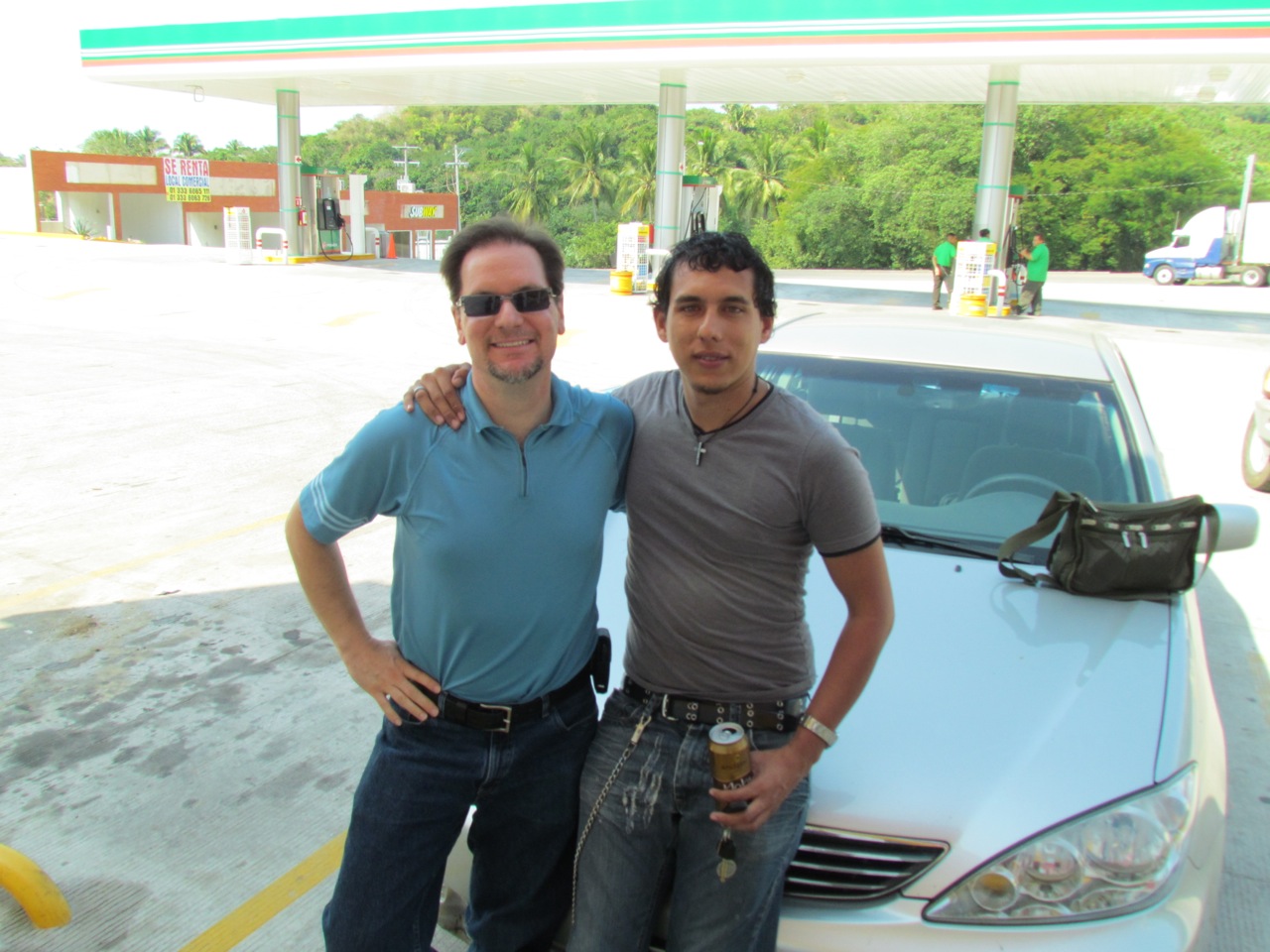
Driving back to Tepic with my nephew
I am very thankful for family who were ready and able to help me travel to Puerto Vallarta twice, a 6 hour return trip by car from their home. My nephew drove us in my dad’s car and was my translator when we had to get the police report and photos. He knew his way around Puerto Vallarta well and we made good time. My brother kindly changed his return ticket too which cost us both an extra fee. The entire process would have been very stressful if I had to use buses and taxis to get to the necessary appointments. I am also very thankful for the people who acted as references for me. I chose people who would be easy to reach by telephone but I did not expect that they would be asked to provide a physical description of me including my eye colour, age and height. 

 My brother and nephew. Why did I leave my purse on the car when I took this picture!?!!
My papers were ready the day we left and I was very happy to make it back to Canadian soil. But in every airport, Puerto Vallarta, Chicago and Toronto, I was removed from the regular immigration and security lineups to have my documentation verified which took extra time. I applied for a new passport right away when I came home and received one in five days. I was warned though that if I lose this one, I cannot get another until after April 2015 which is when my stolen passport would expire. 

I had one other problem arise. My credit card was cancelled because the issuer noted an out of country transaction and we hadn’t informed them of travel plans. I never contacted our credit card issuer about travel plans for our last five trips and had no problems. 

What did I learn, and what will I do differently?
  • I had my passport number (and all other important numbers) in Dropbox but I will make sure I have a scanned copy of all my documents in the future in cloud storage.
  • I will have the phone number/email of the nearest Canadian Consulate with me
  • I will hold my travel documents in my hand when I go through security. 
  • I will ensure that my wallet is in a zipped inner section of my handbag. My passport was in an outer pocket of my handbag and was easily accessible.
  • I will be alert for diversions that take my attention away from by belongings
  • I will have two pieces of photo ID besides my passport. I had no photo ID during my stay in Mexico as my drivers license had to be turned in at the consulate
  • Keep your clothing and luggage simple. Traveling with a tablet rather than a laptop computer is better in security as you can leave a tablet in your bag. 
  • Technology make things easier! Internet access is vital if you have a problem like this. My nephew tethered my iPad to his iPhone to get me internet access in Puerto Vallarta. If he had not been there, I should have purchased a SIM card for Mexico. My brother had international cell phone access but I did not. If I travelled alone I would make sure I had phone/internet access at all times. 
  • Install Skype on your mobile device. I was able to call a Canadian 800 number free of charge on Skype to get my credit card reactivated. Canadian and USA toll free numbers cannot be accessed by land line in other countries. 
  • If you ask friends to be references for a travel document, do them a favour and remind them of your eye colour, height, workplace and age. 
  • Inform your credit card carrier about your travel plans. This can be done online. 
View from the Consular Office in PV
Mexico gets plenty of bad press and is infamous for corruption. But theft can happen anywhere. I read a similar account of a passport theft in security at Heathrow Airport in London England. In the big scheme of things, my lost passport was a minor inconvenience. Dealing with an accident or illness, or losing all your ID and luggage would be far more difficult and stressful. It is best to be prepared for the worst scenario and to have a backup plan before you leave. 

Wednesday, February 06, 2013

January Birding


For the past few years I have enjoyed counting birds in the month of January with the goal of exceeding my previous totals. There are several interesting winter birding sites within an easy drive of our home in Ontario and last January I also counted birds in Mexico. This January was a busy month and there was not much time for intensive birding on my agenda. Nevertheless, I kept my eyes open for birds and added one life bird in Mexico.

Josh Vandermeulen is a young, enthusiastic local birder. In 2012 he did an Ontario Big Year and counted an impressive 374 bird species in our province. His blog Ontario Birds and Herps chronicles his adventures. On January 1st he wrote,

"Often when out birding, my technique can often be summed up like this. See fluttering movement. Move binoculars up to see bird. Bam! Identify it. Move on to the next bird, and repeat. It is easy for me to get into the trap of only viewing the bird for as long as necessary to ID it and then continue on. This can lead to the dangerous trap of over-confidence with identification, and it can also lead to a lack of appreciation of the bird's behaviour, habitat, and other things apart from identification. I will try to force myself to actually spend time sitting still and watching the birds and their behaviours."

This January I had time to watch bird behaviour while visiting my family in Mexico and here are a few discoveries.


I watched an adult Loggerhead Shrike feeding a fledgling just a few metres from the house. The young bird is on the white post and the adult is on the fence wire. There were two fledglings and their loud calls attracted my attention as they competed for parental attention. Offspring of any species keep their parents very busy and these birds were no exception!


A pair of Altimira Orioles caught my eye from the breakfast table while splashing in the bird bath. Looking more closely, I noticed one of their fledglings perched quietly on a nearby orange cluster. It blended in so well that I did not see it until it moved slightly.


At the side corner of the house, two or three Greyish Saltators could be seen foraging in the fruit trees each afternoon. These seed-eating songbirds are common through tropical areas of Central and South America and Mexico is part of their northern range. This was a life bird for me.


I noticed a large population of Blue-grey Gnatcatchers last year in Mexico and they were abundant again this year. In the evening, just before sunset, they would "gnat-catch" along the fence behind the house. I was able to observe them at close range but they are tiny and fast and hard to capture in evening light with a camera.


It was common to startle a flock of these Inca Doves while walking on the property. They blended in so well with the ground cover that I usually did not notice them until they flew upward. These ground feeders like to huddle close together in groups in the sunshine. 

The Egret in the first picture was perched on a branch in the village less than a kilometer from my parents' home. It was in the vicinity of a small stream which coursed near the town square or zocalo and was spotted by my brother as he was driving.

I did a rough tally of birds seen around home in Ontario and very locally in Mexico and came up with 27 birds in each location for a total of 54 birds. That is a fair total for very leisurely birding.

Tuesday, February 05, 2013

A Different Perspective


Life is full of changes, some small, some larger. They add up and can eventually lead us in a different direction with an altered focus. In the past few months my job went from four days a week to full time including weekend rotations. In an effort to maximize rehabilitation outcomes, some of our patients now get therapy seven days a week and staff hours were increased accordingly. I love my job but also enjoy many other activities, so the prospect of a longer work week was not thrilling. I have decided not to be reactive and will wait a while before making further career decisions.


My parents have experienced declining health in recent months and I travelled to Mexico twice between October and January to be with them. They are only 22 years older than me and I see my own mortality in their current situation. Age differences are not as significant when years add up. In all of this, life is still good, busy and rewarding. I see the importance of facing only one day at a time and putting aside worries about a future we cannot fully control. On the other hand I cannot procrastinate in making good decisions regarding relationships, health, lifestyle, career and finances. The immortality of youth is a thing of the past.


It was just ten days ago that my brother drove our parents and myself to a high point of land above the town of San Luis de Lozada. The 360 degree panorama was beautiful and included mountains, the town, a cemetery, an old bull fighting ring, and acres of sugar cane fields. Turkey vultures circled at our level but their perspective was one of survival, not admiring the scenery as we were. My brother and I both took pictures and it was interesting to see how our perspectives varied even though we shared the same time and place. 


Perhaps my introspection is related in part to celebrating another birthday last week. I celebrated in Mexico and in Canada with family and am thankful for the healthy and happy years I have enjoyed throughout my life.


Sunday, November 18, 2012

Los Niños de México


The young doctor came to visit my parent's home one evening last month. Her husband drove and looked after their four year old daughter during the consultation with my mother. I sat at the other end of the chesterfield as Abril clung shyly to her father, barely looking at the English speaking stranger. Pulling out my iPad, I focused the camera on her and she smiled, then laughed, then stood on her head in front of the device. My daughter called on Skype and Abril saw our dog and home two countries and thousands of miles away. The language barrier was overcome with technology and I had a new friend. A few minutes later I got up to peel some hard-boiled eggs and tried my very rudimentary Spanish. "Huevo," I said to Abril. She looked up brightly and said, "Egg, yellow egg." Her kindergarten English topped my Spanish.


Earlier in the week I went to a small town with my brother and sister-in-law for a children's Bible class. The children met at 6:00 PM in the front yard of a very modest house. An unconscious man, drunk or stoned, lay on the sidewalk beside us as the full moon shone down on very dark streets. The children were delightful and wanted me to take pictures and listen to the English words they learned in school. They sang, listened to the story and did their lesson in the poor light. A couple of young teenagers used the light from a cell phone to illuminate the pages.


The waiting room at the cancer centre was exactly that;- a place to wait and wait. A little boy sat with his father while his mother entered the chemotherapy suite. A priest prepared to give the daily mass for the sick and the boy became restless. His dad gave him a cell phone and the child sat on the floor happily playing a game. Medical technology at this hospital was on par with hospitals in Canada and the staff members were knowledgable and efficient.


I walked around the school on my brother's property during classes. The uniformed children arrive at  7:00 AM when the day is still relatively cool (for me) and then leave by 2:00 PM. I looked at a display of pictures of famous people including Christopher Columbus and Steve Jobs. Christopher Columbus changed this part of the world forever but to this generation, Steve Jobs and other technology giants are the explorers of new horizons.


Mexico receives plenty of negative press related to drug violence and corruption. In the faces of the children I see hope and optimism for the future. Through technology they are connected to the global community. Through education and good mentors they hold the potential for change and a brighter tomorrow.

Monday, November 12, 2012

Día de los Muertos

Flowers were for sale everywhere for the Day of the Dead
I spent two weeks in Mexico in October to be with my parents who are struggling with their health. The area they live in is beautiful and I am content being around the property. Our main outings were to the hospital and shops for food and medicine, but we went to a lovely restaurant for breakfast the last day I was there. The day was November 2nd, the Day of the Dead or Día de los Muertos which is a national holiday and a remembrance day of sorts.

A Catrina at the airport
Mexicans do not observe Halloween as we do but November 1st is the day they remember deceased children and the next day is a day to remember deceased adults. The celebrations are a mix of traditional Mexican culture with an injection of Catholicism. Similar observances were marked by the Aztecs centuries ago.

On the way home we stopped by the main cemetery in the city. The adjacent park was filled with elaborately decorated altars containing ofrendas of favorite foods and beverages as well as photos and personal items of the departed. Flowers, wreaths and food were for sale and the mood was celebratory. Marigolds are the flower of choice for this day.

Toward evening we walked to the local cemetery just outside the small village where my family lives. I was surprised to see buildings built over many of the graves, some very elaborate and others very modest. Families sat together visiting and eating. The graves are decorated and in some areas, people stay all night by candle light hoping to visit with the departed.

When I left the next day, I noticed an altar in the Guadalajara airport and a couple of  Catrinas stood in prominent places. I took a lot of pictures and the 2 minute slide show below combines images of the city celebration followed by photos of the village cemetery.

Friday, March 30, 2012

A Prayer for Courage


I read this prayer written by Akanu Ibiam in a book of Lenten devotions a couple of days ago. Fear is a stumbling block for many, an excuse for unfulfilled goals and dreams, and a cause of anxiety and regret. May we be filled with cheerful courage in the face of any challenge.

The words are typed on a picture I took of a desolate stretch of highway in the north of Mexico earlier this year.

Tuesday, January 31, 2012

Big January Birding Totals- 2012

January 1, 2012 in Nayarit, Mexico

It is 4,090 km from our home to my parents' home in Nayarit, Mexico. I estimated that I travelled close to 10,000 km this month while counting birds. I birded in subtropical, desert, ocean, Great Lakes, and snowy climates. I regret not taking my binoculars to Mexico as I missed many bird IDs by using just my camera zoom to view them. But when your suitcase weighs 49.9 pounds, something has to stay home.

Birding in the snow on January 29, 2012

This winter is unusually warm and in our area of Ontario, Canada, 18 days in January were above freezing. I really noticed a difference in local bird populations this year. Our bird feeders are very quiet and I have not refilled them this month. I looked hard but did not find more common winter birds such as Red-breasted Nuthatches, Cedar Waxwings, Rough-legged Hawks, Brown Creepers, to name a few.

Birding on January 31, 2012 on a beautiful sunny afternoon (7 degrees C!)


My monthly total is 93 birds, 54 seen in Canada (compared with 52 in 2011), 43 seen in Mexico, with 4 birds seen in both countries. We travelled to the Pacific coast on December 31, 2011 and it is tempting to add the 15 birds I saw that day, but that list has been kept separate. (There is a tab at the top of this page with all the lists). I added 20 life birds between December 31st and January 31st and I still plan to share more photos and stories about Mexico and Canada.


In the end, it not the numbers that matter, but the enjoyment of getting out and observing nature. After a stressful day at work, there is nothing more relaxing than going to a nearby park to be serenaded by Black-capped Chickadees looking for handouts. These gregarious little birds are my favourite winter species just for the trust they show by landing on my outstretched hand. They always bring a smile to my face.


The January count is just a kick start to a year of bird observation. It is interesting to note seasonal changes as well as variations in annual patterns. Since I started doing January counts in 2009, I have recorded 80 species in Canada in the month even though each year I have seen only 52 to 61 species.

"There is symbolic as well as actual beauty in the migration of the birds... 
There is something infinitely healing in the repeated refrains of nature -- 
the assurance that dawn comes after night, and spring after the winter..."
Rachel Carson 


Saturday, January 14, 2012

Nayarit Yard Birds

Grooved-billed Ani, Hooded Oriole(f), Vermillion Flycatcher, Blue Grosbeak (m) (f), Painted Bunting

The five acres my brother, his family and my parents live on in Nayarit has a variety of bird habitats. There is a meadow where tree seedlings are planted, an orchard which had many ripe citrus fruits, a banana grove, a bamboo stand, a small pond and flowering vines. Sugar cane fields surround the property. I would take a chair, sit in a particular area with my camera and wait for the birds to come. I identified 30 yard birds yet I know there were several species I missed. Some birds, such as the Mexican Yellow-winged Cacique eluded my camera lens as they hid the the bamboo and banana leaves. There is a new tab at the top of the blog with my Big January list to date.

N.Mockingbird, Juv H. Oriole, W. Meadowlark, Loggerhead Shrike, Hooded Oriole(m), Say's Phoebe

Lesser Goldfinch, Common Ground Dove, Pyrrhuloxia, Say's Phoebe, Yellow-rumped Warbler, Lark Sparrow


Saturday, January 07, 2012

Mexican Start for Big January Bird Count

I have participated in a January bird count for the past few years. It is friendly "competition" which encourages me to get out during a long, cold month to look for birds in my area. My Ontario counts are very predictable, but this year I have spent the first eight days of the month in two very different parts of Mexico;- Nayarit and Coahuila. I have counted birds on the properties where my family live as well as one outing to the coast which included a boat ride through a mangrove swamp. Unfortunately I could not bring my binoculars and I really have to look for a good pair of travel bins. I have to look up a few birds when I get home so my count is unconfirmed at this time.
Many warblers winter here and I have been aware of them in the treetops but unable to get good views in the vegetation. Blue-gray Gnatcatchers are abundant but I have also identified a few Audubon Warblers and a Nashville Warbler. Perhaps I will have enough information in some blurry photos to add to this category of birds.
I have learned to identify a variety of doves during this trip. The dusty town where my daughter lives seems overrun with grackles, house sparrows and doves. The smaller Inca Ground Doves have beautiful plumage which blends in well when they rest under shrubs in the sand.
In Nayarit the White-winged and Common Ground Doves were more prevalent.
As far as I can tell, all doves sound pretty much the same and they are all well adapted to areas of human habitation. The last dove arrived in North America fairly recently from Europe. A few Eurasian Collared Doves were introduced the Bahamas in the 1970's and the rapidly spread in North America.