Showing posts with label people and places. Show all posts

Friday, December 21, 2018

Winter Solstice


After six months of shortening days, we make a U-turn and enjoy the gradual lengthening of daylight hours. The change is barely noticeable at first but by mid-January the longer days make a difference.

There are numerous holidays around the world that celebrate light. We live about 90 minutes from Niagara Falls, Ontario where there is a Winter Festival of Lights from early November until the end of January. Several kilometers of light displays run from the Rainbow Bridge to Dufferin Islands along with the usual lights on the American and Canadian Falls. It really is a winter wonderland at night and worth visiting if you are in the area.


A natural light show tonight is hidden by a thick cloud cover courtesy of a storm system that brought a lot of rain yesterday and today. The full Cold Moon, a meteor shower and seven planets will appear over the next eight hours.

We are indoors with candles burning and tree lights brightening the room. I made a double chocolate yule log to celebrate this special day as we begin our journey to summer.


Monday, November 05, 2018

A Visit to the 9/11 Memorial


We enjoyed a 5 day vacation in New York City this August. I booked the trip mainly because I wanted to see Come From Away on Broadway and that was a memorable highlight of the trip. I went to NYC with our daughters in 2008 and while some things were little changed, we explored several areas that were new to us. A city this big is impossible to cover in a few days

We spent a morning in the area of the 9/11 Memorial and Museum. The design of the museum, grounds and the adjacent Oculus centre is beautiful and highly symbolic. I saw several visitors expressing raw grief and I wondered at their loss and connection to the site. There were thousands of messages incorporated in the exhibits and they spoke of love, courage, sacrifice, forgiveness, and resilience. The best of human behaviour often shines in times of great loss and one could not help but be moved by the stories that were featured. America appears as a divided, unhinged country from my view in Canada, but we talked with many rational and thoughtful people in Manhattan who do not mirror their leader in attitude or behaviour. 

I will watch the midterm election results with interest tomorrow but whatever the outcome, I will remember with hope the good will that was represented at the memorial. We tend to forget the past so quickly. 

Here are a few pictures of the area. I would highly recommend taking the time to visit New York City. We went on a bus tour that offered some scheduled events as well as daily drop offs in the city which gave us plenty of free time to explore on our own. There were school-aged children in our group and I commend their parents for giving them a good introduction to the city.

Large fountains mark the foundations of the original twin towers. The names of the victims of the attack are inscribed here.

The Survivor Tree, replanted outside the 9/11 memorial, speaks of resilience in the face of adversity. I am carrying a Love is Stronger than Hate tote bag purchased at the museum.

The Oculus houses a transportation hub and the Westfield mall. Tour guides were available to explain the symbolism of the interesting building. 

The windows of the Oculus frame the new WTC tower. The light on the floor shines where the original building fell.


Monday, December 05, 2016

Christmas Customs and Culture

Christkindl Christmas Market

We attended the annual Christkindl Christmas market in our city this weekend. Our area was settled largely by German speaking immigrants a couple of centuries ago and while we are far more diverse now, Oktoberfest and the Christmas market are well attended events.

Traditional German band with an alpenhorn 

I asked a Hindu nurse at work if there were any December celebrations in her culture. She said no, but she planned to put up a Christmas tree and exchange gifts with friends and family. To her, it was a Canadian tradition she felt comfortable adopting. Other acquaintances are celebrating St. Nicholas Day tonight and tomorrow in the Dutch tradition. There was a Krampus run this weekend along with the Christmas market to celebrate some darker European Yuletide legends. 

Krampus is here                                                                        Catalonian Caganer (source)

Catalonian nativity scenes feature a figure who is defecating in a corner or behind a tree. The “Caganer"  or “pooper” is a symbol of fertility and good fortune in an agrarian society. He may also represent the fact that Jesus was a partaker of everything that is human. I work in an environment where regularity or irregularity is recorded and dealing with excrement is all in a day’s work. It is something common to all species who eat food, whether rich or poor, young or old, famous or infamous. It is part of our humanity. 

In Mexico, Christmas posadas are community events where participants go from house to house looking for the Christ Child. In parts of Newfoundland, Mummers go from house to house looking for food and drink in exchange for music and dancing.

Joseph at the Christkindl Market
I truly doubt that our nativity scenes depicting the birth of Jesus are even close to what really happened. In my mind, Mary and Joseph were likely staying with relatives in the autumn of the year. The lower part of the building housed the animals and the couple stayed there, as the guest room was occupied. They shared meals with others who were hospitable and generous. They may have been guests for days or weeks before the birth. Mary was not alone during labour but was attended by a local midwife and caring women. They were not isolated on a hill far from town but were part of the normal hum and rhythm of the community.

Legend and tradition have become the mainstay of our December celebrations with each culture interpreting the story according to their own history and perspective. Community is central to the celebration. I am fortunate to be able to participate in my community’s Christmas celebrations. Maybe someday I will have a chance to visit Spain and encounter a Caganer as part of their interpretation of the Christmas story.

Sunday, October 02, 2016

Québec City by Calèche

My first calèche ride, Québec City 1972

Grandma took me on a bus tour of Québec the summer I was seventeen and she was seventy-seven. My mother had taken the same route with her when she was a teenager. Grandma wanted me to ride a calèche in Québec City and see the birds on Percé Rock, far east of the big cities. Everyone on the bus called her Grandma by the end of the two week trip. There was only one other passenger my age who was travelling with her parents but we all had a great time. 

I took our daughters to Québec in 1998 when they were teenagers and told them Grandma’s stories. I re-read her copies of The Golden Dog by William Kirby and Maria Chapdelaine by Louis Hémon. We went to Halifax and Prince Edward Island instead of Percé but stayed a few days at Ste. Anne de Beaupré as a base for our exploration of the Québec City area. And we toured the city by calèche.

Québec City 1998

Last month my husband and I visited Montreal and Québec City for a few days. Both cities are rich in the history and culture of Europe and the New World. We walked the upper and lower sections of Old Québec City and took the ferry to Lévis on the other side of the St. Lawrence River. We had some extra time on the last day and decided to take a tour of the upper city by calèche for Grandma. The limestone buildings and the Plains of Abraham were warmed by the low sun of a September afternoon and our driver chatted amicably with his lilting French accent. So much has changed and so much has not changed in the past forty-four years since I was seventeen. 

September 2016

The slide show has a short video clip in the middle of our horse-drawn tour through the old walled city. One thing that has changed dramatically over the years is the quality of cameras. I have 12 faded colour snapshots of the two week trip we took in 1972.

Saturday, August 20, 2016

Vacation


Sun and shadow shroud the cliffs of the Grand Canyon as a
   Condor soars on air currents high above the Colorado River.
The San Francisco peaks are on the horizon but you cannot
   hear clanging cable cars, 
      see the Golden Gate Bridge or
         feel the ghosts of Alcatraz in the same-named city.

Pacific waters ripple over my feet in British Columbia, Ventura,
   and remote Mexican beaches with pelicans.
Cold Atlantic waves chill me in Newfoundland, Fundy, Rhode Island, 
   and New York City by the Statue of Liberty.
I stand atop Sulphur Mountain, Mount Washington, and float in the fault that
   holds the Dead Sea.

We cross Canada by land and sea from Victoria to Cape Spear, 
   over mountains, through prairies and forests, 
      and hear a loon laugh, the moon mirrored on a quiet lake. 
I listen to music in concert halls, on streets, in the hum of markets
   in Boston, Vancouver, Jerusalem, Guadalajara,
      and at home.

I ride a camel, travel by air, ocean liner, train, bicycle, bus 
   and drive California State Route 1.
History beckons from castles, cathedrals, communities, 
   and the Alamo.
Our world is large, yet closer, smaller and more
   accessible in modern times.

I watch a bright yellow Goldfinch tentatively
   remove a seed from a dead flower in my garden and
      wash it down with a sip from the bird bath beside me.
The search for beauty, relationship, rest, holiness,
   amidst the clamour of life brings
      a holiday for my soul.


Saturday, August 13, 2016

First World Problem: How Do We Help the Third World?


I watched her grow from a child to a young teenager over the past six years while visiting my family in Mexico. She lives with her parents and brothers in a small cement house on the five acre property. Her dad helps care for my elderly father and also maintains the grounds of the school, factory and houses. Her mom, Irma, who gave my mother loving personal care when she was ill, cleans the home and also works at my brother’s guava factory. Fatima's innocent charm, wide smile and helpful nature made me want to scoop her up and bring her home with me. But she is the apple of her father’s eye and her mother’s pride and joy. She is where she belongs.

With Irma and Fatima at my mother's funeral

Many people from first world countries visit poorer countries on short term mission trips or secular volunteer opportunities. The Mental Health Unit at our hospital has partnered with medical professionals in Guyana. Staff members use vacation time for teaching and training in an effort to set up better mental health services in that country. I know retired people who work with local people in third world countries in their area of expertise. Other volunteers and agencies respond and provide urgently needed aid after natural or man-made disasters. These are worthwhile, productive endeavours. 

There are critics of short term mission trips. Participants are eager to visit a poor area, bring gifts, build structures, evangelize, play with orphans and then go home in a week or two with plenty of pictures and a feeling of self-fulfillment. The focus is on how much the first world volunteers have to offer, not on the strengths and capabilities of the local people. The motives of the volunteers may be sincere but misguided. I have seen people leave Canada with suitcases filled with blankets, candies, school supplies and clothing to distribute to the “poor and needy”. But the definition of poverty is relative and care is needed to avoid conveying a sense of superiority because of our affluence. Gift-bearing volunteers may not understand the values of the community and can undermine the local economy. 

No "Shoebox" gifts required (photo by my brother, Mark)

We used to fill a couple of shoe boxes with recommended items each year at Christmas time for distribution to needy children. It appeared to be an unselfish thing to do in the spirit of the season. The boxes are collected, unpacked and checked by volunteers at a warehouse and then distributed around the world. The practice makes little sense socially or economically. The purchased items are usually inexpensive imported goods that may have been made by underpaid workers in another third world country. They are then sent by air to a community that may not share our values or holidays. Once again the local economy in the poorer country loses out as “free” items are given to “needy” children. The donors feel good, but the money could be put to better use.

People who are materially poor may be rich in relationships, community, meaningful work, and happiness.   
Conversely, the materially rich may be poor in relationships, meaningful purpose and contentment. 

Eugene Peterson recently tweeted, 

“Living in the land of the free has not made us free. We are a nation of addicts and complainers.” 

He spoke as an American but his statement is true in many developed nations. We may forget that strain in life builds strength of character, just as lifting weights develops physical strength. 

Visiting third world countries is a valuable learning experience. I remember visiting a home in a Mexican village in 2006 with my brother, who came to pay the man for work he had done. The adobe and tin house had a dirt floor and chickens walked in and out the door. A TV was on the table and an extension cord ran to an outside power source. The family received us with great hospitality and offered us a drink. I wanted to take a picture of the surroundings but knew it was not appropriate. The FIFA World Cup was in progress and Mexico was playing a game that day. While we were there, Mexico scored a goal and a great roar rose from the hills as everyone living on that mountain cheered. These people enjoyed community, had their basic needs met, and were content in their circumstances in spite of their relative poverty. 

Roadside Restaurant- Mexico (delicious gorditas!)

We need to share resources in collaboration with people who live in poorer nations. Education is essential and children often need uniforms, books and tuition to go to school. There are charities that work to address the root causes of poverty. People in third world countries have a voice, dignity, potential and ability to achieve their dreams. We cannot jump in and impose our values on them but need to listen and view their world from their perspective. It is important to do our research before giving to charities to make sure that the organization is using funds to empower the recipients, and not making them dependent on handouts. The same principles are important when dealing with poverty at home. 

Robert D. Lupton wrote an thought-provoking book, Toxic Charity: How Churches and Charities Hurt Those They Help (And How to Reverse It). He recommends an "Oath for Compassionate Service" with six guidelines: 
  1. Never do for the poor what they can do for themselves; 
  2. Limit one-way giving to emergencies; 
  3. Empower the poor through employment, lending, and investing, using grants sparingly to reinforce achievements; 
  4. Subordinate self-interest to the needs of those being served; 
  5. Listen closely to those you seek to help; 
  6. Above all, do no harm.
Other resources:
Poverty, Inc. - I highly recommend this documentary, available on Netflix and elsewhere
When Helping Hurts- a book with similar themes as Toxic Charity
Living on One - Two documentaries available on Netflix
Barbie Savior- Satirical look at the "white saviour" complex

Monday, June 27, 2016

Finding a Table


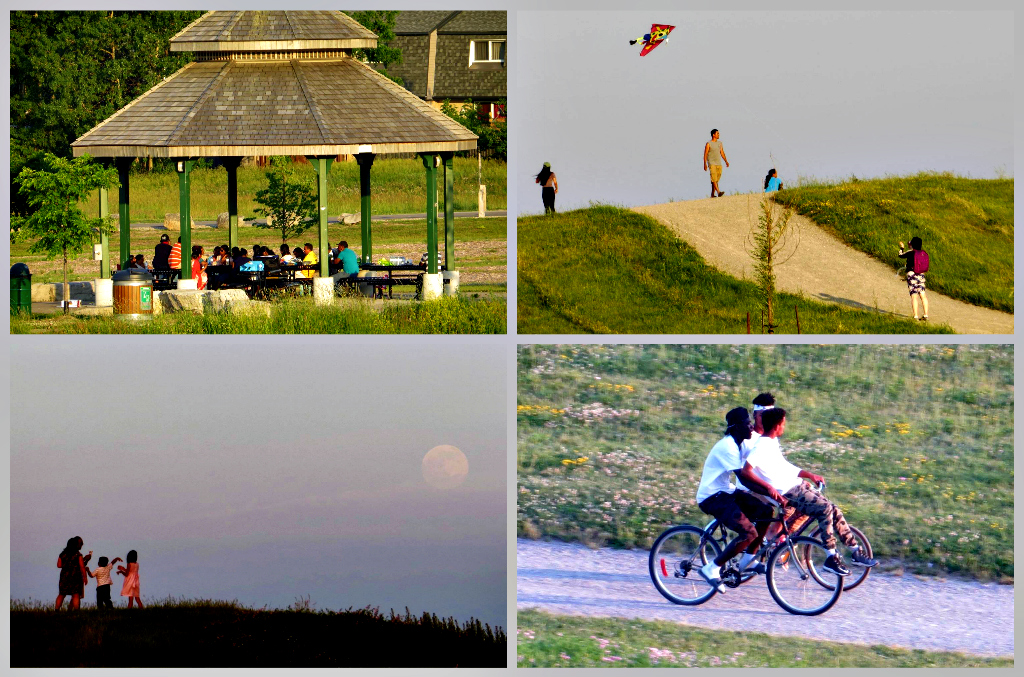
Summer arrived a week ago I watched the solstice sun set and full moon rise over the city. The park near our home is well used by people in the neighbourhood, particularly by families who have moved here recently from other countries. Our city was very white when I came here 40 years ago but now we have a diversity of cultures represented. The newer immigrants tend to live in nearby apartments and row housing without the benefit of large yards. That could be one reason they come and spend evenings in the park. I admire their sense of family and community. We shop at a nearby international food market for items like injera, less common spices and pulses and other treats from the middle east and south-east Asia. The young, friendly cashiers in their hijabs speak English without an accent while shoppers from older generations prefer to use their native languages in the store. It does not take long to assimilate children to a new culture but it is harder for adults to find a place in the community.


I go to the Apple store at the mall a couple of times a year. It is my favourite retail experience of all time. The store is inviting, the staff are helpful but not pushy, you can use the displayed devices for as long as you want, children are welcome, questions are answered, lessons are available, and the customer is truly most important. It is an ideal set up for meaningful social interaction and I think churches could take some tips from the store. Come in, ask questions, share, learn, discuss face to face rather than looking at the back of heads in front of you. And all of this is done without pressure or judgment as employees are not allowed to speak negatively about each other or the customer. It reminds me of “The Great Hall” in C. S. Lewis’ Mere Christianity where people from all walks of life and different “rooms” come to discuss spiritual things together. 

An “Apple store” approach would be useful in getting to know and understand our neighbours from other countries. We all have things in common. The fear-mongering rhetoric concerning immigrants in America and in Great Britain during the recent Brexit referendum is destructive and regressive. We need to find a common table and take time to get to know and value the people in our neighbourhoods. I am proud that Canada continues to accept refugees and immigrants as it has for many years. But it takes work to build friendships and community with mutual respect and trust.


Monday, May 02, 2016

Spring Horse Auction


We have the most interesting year-round markets in our region, the largest being the St Jacobs Farmers Market which is north of the city. On Friday and Saturday, a large horse auction was held on the grounds of the market. This is a significant event for the region's Old Order Mennonite population and they came in large numbers. The horses I saw auctioned were sold in the three to four thousand dollar range. It is not unusual for a larger buggy to be pulled by two horses making their transportation costs similar to the purchase of a used car. 

I find it interesting to watch the Old Order Mennonite children. They are well behaved and participate in adult activities without complaint or special attention. I also had to smile when I heard the descriptions of the horses before they were led into the ring. Some were featured as "buggy broke" "church broke" and "traffic broke" along with their age, parentage and current owner. 

I didn't have much time to linger on Saturday after we did our market shopping but managed to take enough photos to put this short movie/slide show together.

Sunday, May 24, 2015

Bird Music


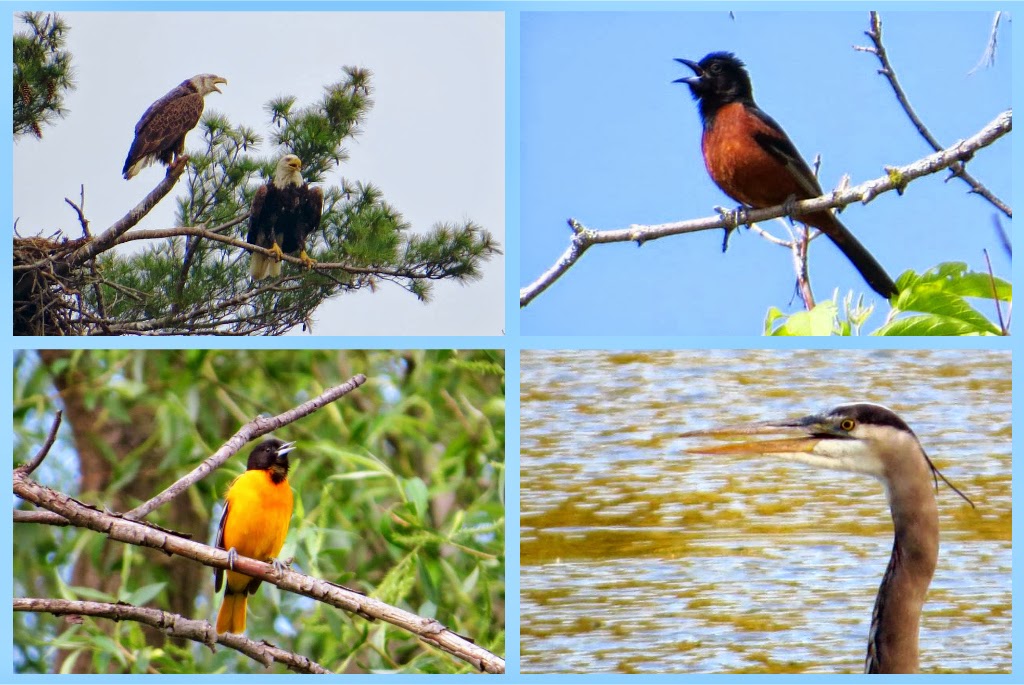
Bald Eagle, Orchard Oriole, Baltimore Oriole, Great Blue Heron

Months of bitter winter cold kept me hostage indoors earlier this year. Spring came late and then rushed by with wide temperature ranges and little rain. Forsythia and lilacs bloomed together in some areas instead of a month apart as usual. Spring birds returned in a trickle and then in a flood over the past two weeks. The forest canopy opened quickly making it hard to see some of our smallest songbirds. But the woods, marshes and meadows are alive with birdsong. I have the songs and calls of all the birds of Eastern North America on my iPod and I listen to them in the car, hoping to become familiar with more of them.

Brown Thrasher, Red-winged Blackbird (2), Norther Flicker

Songbirds learn their species' sounds in the first few days and weeks of life. Occasionally there are regional variations. Some birds have a repertoire of a couple of songs while others may have many more calls and melodies. A few birds like Mockingbirds and parrots are able to imitate sounds they hear from other birds, humans or machines. I visited a patient once who had a parrot who said hello every time the phone rang. Some birds can learn another species' song if they are adopted into that bird's nest shortly after birth. But on the whole, listening is a reliable way to identify many birds. I followed the sound of a Pine Warbler and after fifteen minutes of neck-stretching searching, found it on the top of the tallest pine tree. Birds, especially the males, are often more vocal in the spring as they establish nesting territories and go through mating rituals.

Savannah Sparrow, Rose-breasted Grosbeak, Pine Warbler, Bobolink

Like birds, humans learn language and music beginning in infancy even though words and melody activate different areas of the brain. We know that children can learn other languages without an accent if they are exposed before adulthood. I came to Canada as a school child with a strong South African accent, but it was gone in a few months. Adults hold on to an accent for life. The music styles we are exposed to when we are young tend to become our preferences for life. I do not understand eastern music with its alternate scales and tones and it would be difficult for me to learn it now. Exposure to various music styles at an early age increases our understanding and enjoyment of more genres of music as we get older.

American Goldfinch. Female Red-winged Blackbird, Yellow Warbler

Music is often at the centre of generational separation and conflict. My generation of baby boomers embraced rock and roll in the 1960's to the consternation of our parents. Rap, heavy metal, ska, and electronica appealed to our children and we didn't care for it. There are so many sub-genres of music now that our ability to sing together as a multi-generational community is greatly reduced. (country, folk and bluegrass music may be exceptions to this). My daughter and son-in-law took us to see Mozart's The Marriage of Figaro at the National Arts Centre this year. We commented on the white-haired patrons who made up the majority of the audience, just like the demographic of many churches.


These young siblings played classical selections skillfully at our local market last week. They will always understand and enjoy this music style. Why not expose children to a large musical heritage as their brains form musical memory;- ancient, classical, cultural, spiritual, modern and post-modern? They will explore the new sounds of their generation on their own but maybe we will have some songs we can sing together around a campfire or a concert we can enjoy together.

I am challenged when I try to understand and appreciate music forms outside of my experience. If I can learn new bird songs, surely I can learn some new music too.

Music isn't just for the birds.

Song Sparrow


Sunday, November 30, 2014

Set the Oppressed Free

Young boy in the village of  El Ahualamo MX 

I travelled last month to Mexico to visit my family for the first time since April 2013 when my mother died. My dad has struggled with his health and it has not been easy for him to find a new normal without her around. Last year we quickly packed up Mom's clothes and personal things but during this trip we went through cupboards, shelves and drawers more thoroughly. Many of her books were full of mildew and had to be burned. I found myself drawn to old family photographs, scrapbooks and handwritten recipes in the old wooden recipe box. Most of the other things she had collected over the years were not worth bringing back to Canada. My house is full of stuff, too full in fact of items I never use. One of our daughters said, a little facetiously, that we need a good fire because she doesn't want to sort through our belongings in the future.


I did bring home these Goebel porcelain pieces entitled "Flight into Egypt". Mary and Joseph are depicted as refugees, fleeing the evil wrath of King Herod with the young child Jesus. I recently discovered Steve Bell, a Canadian singer-songwriter who has two thoughtful Advent -Christmas albums I have listened to often over the past few weeks. The song "Refugee" from the album "Keening for the Dawn" is based on a poem by Malcolm Guite.

We think of him as safe beneath the steeple,

Or cosy in a crib beside the font,

But he is with a million displaced people

On the long road of weariness and want...

Church under an ancient sycamore tree in El Ahualamo, MX

The needs of poor and displaced people in the world are so great and complex that it is hard to know how to make a difference. Jesus stated his purpose and ministry in Luke 4:18 when he quoted the words of Isaiah.

"The Spirit of the Lord is on me, because he has anointed me to proclaim good news to the poor. He has sent me to proclaim freedom for the prisoners and recovery of sight for the blind, to set the oppressed free..."

There are ways we can make a difference in our neighbourhoods, cities, country and world with our time and money. I know several people who came to Canada as refugees. I know even more who are sick, lonely and discouraged. I know of good organizations that assist people in need around the world in a respectful manner.

One thing is certain...I have no needs this season by good fortune of birth, family, citizenship and employment. With that comes responsibility to use and share wisely what I have been given.

Saturday, May 03, 2014

A Visit to Toronto's Distillery District


I visited a good friend in Toronto who took me on a tour of the Distillery District .The site was once The Gooderman and Worts Distillery and stands near the lakefront, west of the downtown core. There is plenty of construction in the area as Toronto prepares to host the 2015 PanAm Games. The athlete's village is just west and adjacent in the Canary District. When the games are over there will be a large number of residential units available along with retail and recreational facilities. 


This was an unpleasant part of Toronto when I lived here in the 1960s and it is amazing to see the transformation of the old limestone and brick buildings which are well over 150 years old. It is not surprising that it is a popular spot for movie shoots, weddings, photography and tourism. Today was rainy and cold, the sky and light uninspiring for pictures. I have to return on a sunny morning or evening in the summer.


There were plenty of shops to step into to get out of the rain. We looked at antiques, spices, art, chocolate, vintage and eco clothing, and much more.


The area is described by National Geographic as "A hip new neighbourhood within the best preserved collection of Victorian industrial architecture in Canada". If they mean "hip" as in "hipster" there were a few of them as well along with many people of diverse backgrounds. A marching band of teenagers from Chicago played a few songs in the rain which was rather random but added to the eclectic charm of the cobblestone courtyard.


Toronto has many interesting neighbourhoods and this one is well worth a visit. As a bonus it is a short distance from Tommy Thompson Park, one of the best birding areas in the city. My friend drove me through the trendy Cabbagetown neighbourhood and we followed the Don River Valley back to her home. We saw a couple of blooming forsythia and magnolia trees but leaves are not yet out on the trees. She took a little detour to show me a small green space that was a mass of blue Scilla flowers. Spring will surely arrive this week!

Thursday, September 05, 2013

This Market is NOT Destroyed!


A devastating fire early Labour Day morning levelled the main building of the St. Jacobs market just north of Waterloo, Ontario. Sixty vendors occupied the two storey wood building which was packed with local shoppers and tourists on market days. I have visited many markets and very few in North America compare with this one. Tuesday's sensational newspaper headline informed us the market was destroyed and the picture appeared to confirm the announcement.

We moved to Kitchener in December 1970. My mother was a very industrious homemaker and rode her bicycle to the Kitchener Stockyards market near the railway tracks at River Rd and Hwy 7 to buy produce. At that time Kitchener had a thriving downtown outdoor market but in the early 1970s the old city hall was demolished and the market was moved to the basement of a new mall and parking garage. The soul of the Kitchener Market withered and many vendors, including Old Order Mennonites stopped selling their goods at the new market. The Kitchener Stockyard merged with the Waterloo Stockyard near St. Jacobs and a new outdoor market started to grow north of the city. A few years later the main market building was constructed and the market expanded quickly becoming a major tourist attraction.

Hot apple fritters were worth the drive to the market
When our children were young I took them to the Stockyard Market most Thursdays. They loved to walk the catwalk above the livestock pens in the auction building (no longer possible) and we bought apple fritters or mini donuts for a treat. The lineup for apple fritters usually extended far out the doorway in the middle picture.

Inside the building after the fire and before the fire
The open concept two storey market building had food vendors downstairs and craft vendors upstairs. It was a challenge to move through the aisles on Saturday mornings as people crowded around counters waiting for their turn to be served.
Outside the building before and after the fire
Vendors selling food, clothing, and household goods had stalls under the porches of the market building. There is an extensive outdoor market and the auction building houses a flea market, general merchandise and another food court.

Today the market re-opened just three days after the fire and I arrived early before work. Some vendors were still unpacking but I quickly found the fresh apples and tomatoes I wanted.


The heat of the fire damaged a nearby Conestoga wagon and signs at the entrance to the auction building. The firemen did a good job of keeping the fire from spreading to other structures.


Today's market was a celebration of harvest, of life and perseverance. The community came out to support the three hundred remaining vendors. The sixty vendors affected by the fire suffered significant losses but people are rallying to help them through this crisis.


This market is not a building. It is made up of people who sell and buy and meet with friends. Burned posts stand in the background but life goes on in the foreground.


Don't believe the newspaper headline. It was written by someone who does not feel the heartbeat of this community. This market is NOT destroyed! 

Monday, July 08, 2013

Entropy

The old couple loved the camp on the shores of the big lake. The winterized home where they lived for decades was clean and inviting. She tended the rose bushes at the entrance and hung planters with brightly coloured begonias beside the bridge that crossed the small creek beside the house. Friends dropped by during the long afternoons and sat outside and visited.

The small housekeeping cabins on the other side of the creek sagged with age, tilting toward the lake more after each spring thaw. Every year he inspected them for winter damage and turned on the water and electricity. The rooms were spotlessly cleaned and readied for the succession of guests who came through the summer months. Summer was a busy season, cutting lawns, removing garbage, fixing boat motors, tending to the guests' needs, sharing fishing tips, and being available day and night.

She died suddenly one winter and he went through the motions of running the camp for another season and then another. His broken heart started failing but he pressed on making frequent visits to doctors in the distant city along with his usual chores. His stiffened joints ached but he kept going for the customers. Each year he was reluctant to book for next season but names were recorded on the calendar and the guests returned.

He finally put the camp up for sale and moved to town. The young couple bought it with money they made from their high paying professional careers in another province. They set up a website and wrote about their plans for the future. They bought two big boats and a fancy tractor. They were nice people but they didn't love the camp. It was an investment, a piece of real estate, not a part of their personal history. He flew in now and then to check things out. They came for a month in the summer and stayed in the big cottage down the road. The house by the creek was empty and neglected. Weeds choked out the roses and the flower pots were dried and cracked. Nature gained an upper hand quickly without diligent daily care. The camp had internet now and he was available by cell phone but the grounds needed a caretaker, an overseer, a real person in charge.

It is the peak of the summer season. All the cabins are empty save one and the grounds are silent but for birdsong and the lapping waves on the empty beach. The bridge is crumbling, the new big boats sit unused at the dock. The swings on the lawn are unused and creek is choked with weeds. It is more like a ghost town than a peaceful paradise.

The old couple loved the camp on the shores of the big lake. I am glad they cannot see it now.

Monday, November 12, 2012

Día de los Muertos

Flowers were for sale everywhere for the Day of the Dead
I spent two weeks in Mexico in October to be with my parents who are struggling with their health. The area they live in is beautiful and I am content being around the property. Our main outings were to the hospital and shops for food and medicine, but we went to a lovely restaurant for breakfast the last day I was there. The day was November 2nd, the Day of the Dead or Día de los Muertos which is a national holiday and a remembrance day of sorts.

A Catrina at the airport
Mexicans do not observe Halloween as we do but November 1st is the day they remember deceased children and the next day is a day to remember deceased adults. The celebrations are a mix of traditional Mexican culture with an injection of Catholicism. Similar observances were marked by the Aztecs centuries ago.

On the way home we stopped by the main cemetery in the city. The adjacent park was filled with elaborately decorated altars containing ofrendas of favorite foods and beverages as well as photos and personal items of the departed. Flowers, wreaths and food were for sale and the mood was celebratory. Marigolds are the flower of choice for this day.

Toward evening we walked to the local cemetery just outside the small village where my family lives. I was surprised to see buildings built over many of the graves, some very elaborate and others very modest. Families sat together visiting and eating. The graves are decorated and in some areas, people stay all night by candle light hoping to visit with the departed.

When I left the next day, I noticed an altar in the Guadalajara airport and a couple of  Catrinas stood in prominent places. I took a lot of pictures and the 2 minute slide show below combines images of the city celebration followed by photos of the village cemetery.