Sunday, April 24, 2016

Perceptions of a Pretentious Past

Our neighbour places artificial flowers in her window boxes and planters in the summer. Not just a few flowers, but lots of dollar store blooms. There is no need to water or dead-head them and their perfect shapes do not wilt in a heat wave. 

My Canadian parents went to South Africa as lay missionaries two years after they were married and I was born in Pretoria. The country was part of the British Commonwealth and colonial, idealistic attitudes prevailed. Missionary story books of that era referred to native people as “savages” who needed salvation. The Enid Blyton books I loved as a child also had racist overtones and current editions are edited significantly. Apartheid policies created a segregated society but our family was in the elite class even though we were far from wealthy. Our black servant lived in a separate small one room structure behind our house. I remember going on the “non-european” bus with her occasionally when she was running an errand. This was the way things were and there was nothing wrong with race relations in my world. South Africa was going through social upheaval at the time but my white life was as beautiful as my neighbour’s window boxes and planters. 

Our family returned to Canada when I was in Grade 3 and we lived in the Toronto area for the next eight years. We attended a church in the city that was even more conservative than society in general. The congregation had a number of black members from Jamaica. They sat together on the left side of the church and the white members clustered together because that was the way everyone liked it. The Jamaicans were lively, friendly people but they socialized and married within their own group and I never remember visiting their homes.

I became friends with Carol, a Jamaican girl my age. We were in the same Sunday School class and sometimes we sat together during church. I remember asking Carol to come to our house after church for dinner as my guest. She was surprised at the invitation and said her father would not allow it. For the first time in my 12 years I realized that there was an unjust divide between black and white people. The civil rights movement was in full swing at the time, but I was oblivious to what was going on south of the border. 

I began reading library books about slavery, the underground railway and the inhuman treatment of Africans who were brought to the Americas. I remember writing my thoughts about racism on pages of foolscap in passionate paragraphs that flowed from my troubled mind. In talking to my parents about my discoveries, I was shocked to find out that my own grandmother was born in Jamaica to a white mother and black father. We visited her often and she was fair-skinned in my opinion, not black, especially when compared to the Africans I knew. But I learned that she was the first woman “of colour” to live in the small town north of Toronto. To this day my father has never liked to talk about his mother’s heritage and I wondered what words he heard growing up as a child. Would Grandma have been allowed to live in our neighbourhood in South Africa? Probably not. 

Snapchat -a silly filter that hides the real me!
Thus began my awareness that things are not always as they appear and injustice is real. I persisted with my invitation and Carol eventually did come to our home for a visit. My parents were kind and well-intentioned, but they created a facade that hid more secrets than the racial background of my grandmother. While some people tend to over-share their personal lives now, I wish I had known and learned from the imperfections of people I was close to as a child and young adult. Things like mental illness, poverty, family discord, marital unfaithfulness, divorce, religious animosity were problems other people had, not us. 

And that is as true as the flowers in my neighbour’s flower boxes and planters. 


Friday, April 22, 2016

Three Years


She left us reluctantly, wanting another ten or fifteen years of good living.

Mom was six years younger than her namesake, Queen Elizabeth who turned 90 yesterday. She would have enjoyed looking at the pictures of the queen’s birthday celebrations and fully expected to reach 90 herself. Instead, we remember her departure three years ago today.


I am 4,093 km from her grave tonight and cannot visit. But there is a full moon this evening and grey rain clouds broke open in the afternoon. We climbed to the top of a nearby hill and waited for moonrise. 

The same full moon shines tonight on her resting place and on family members who are scattered across the world. 

The sun set behind us and bird song filled the dusk air. A brisk north wind chilled us to the bone and Jupiter shone brightly overhead. 


The moon was slow to break through the low clouds on the horizon but it did rise;- as reluctantly as she left. 

Sunset, moonrise,
Dawn, dusk, 
Light, darkness,  
Brightness, shadow, 
Life, death, remembrance and eternal hope. 


Sunday, April 17, 2016

Coming Full Circle

My first blog post in July 2006 was short and experimental. 

“To help keep your brain young and prevent memory loss, avoid living on autopilot -- doing the same things day after day. If you stretch yourself mentally, you'll actually avoid brain shrinkage. The classic way to do that is to learn something new -- whether it's speaking Spanish or playing the harmonica. Like muscles, your brain grows when it's working beyond its normal routine." YOU: The Owner's Manual. Roizen, M. F., Oz, M. C., New York: HarperCollins, 2005.

So, in an effort to avoid mental decay, here is my first effort at blogging.”

I cautiously explored sharing memories and family history. Very early on I discovered Laura’s blog and was impressed with her beautiful writing and interest in the natural world. I was delighted when she was the first person to write a comment on one of my posts. She influenced my early blogging more than anyone else. Over time I met many interesting people, several of them in this group, and our lives intersected through regular blogging. And my mom became my most ardent follower. 

I joined Facebook in July 2007. It was a great way to stay in touch with my family who are scattered across the world. I blogged with enthusiasm and shared on Facebook daily for several years. The year 2012 brought significant change. I was forced by my employer to work full time rather than four days a week and weekends were added to my schedule. My mom was terminally ill and I travelled to Mexico several times in her last year. My blog roll was so large that reading and commenting became an onerous obligation, not a pleasure. And my main motivation for blogging died with Mom in April 2013.

Last year I signed off Facebook as well. I was tired of memes and advertising and outrageously inaccurate posts that made me angry and demanded correction. Quite frankly, I didn’t think I could follow another American election on Facebook. I began to explore other creative outlets. I bought an adult colouring book, I started writing in longhand in a journal. I read more books, played the piano, rode my bike in the afternoons after work and tried to find the balance between my real world and the online world. 

I haven’t missed a year of blogging but March 30th this year marked my first post in nine months. I have changed in the past 10 years. I have more questions and fewer answers. Sometimes I am bursting to tell a story or to share an insight with someone other than my journal. I remain keenly interested in spirituality, health, nature, history and relationships so the focus of my blogging remains the same. I want to experience life mindfully and creatively.

Jayne’s invitation to share with the Comeback Bloggers group didn’t require a second thought. I look forward to revisiting my original reason for blogging...

“To help keep your brain young and prevent memory loss, avoid living on autopilot…”

...as well as renewing friendships and engaging in a creative and emotionally rewarding way of sharing experiences and insights on life's journey.


Friday, April 15, 2016

Two Hundred Years of History


Our region is investing in a controversial, expensive light rail project that will connect the twin cities via the main thoroughfare, King Street. These cities were settled in the late 18th- early 19th century by Mennonites from Lancaster and Bucks counties in Pennsylvania. My husband’s ancestors arrived from Bucks County in 1799. 

The streets involved in the project have been torn up for the past 18 months. The road in front of the hospital has been inaccessible and ambulances enter from the back. Businesses along the route are closing at an alarming rate and while the rail line should be good for business eventually, it is hard for owners to hold on to their customers in the interim.


A few weeks ago construction workers uncovered an old corduroy road in Waterloo a few metres below the current roadway. Ontario law demands an archeological assessment for finds like this and the work has been halted while the old logs are assessed. The region was very swampy and forested and the logs provided a rough roadway to navigate through the drainage basin of Laurel Creek. The archeologist suggested that it was built by Lancaster County Mennonites between 1790 and 1816 who brought this corduroy road style from Pennsylvania.

Two hundred years of history has been unearthed in a city whose main street is now dominated by asphalt, electricity, oil, motorized vehicles, universities, "Tech" industry, malls, coffee shops, and restaurants. The find is fascinating but we are hoping the rail project will start up again and this 200 year old commercial thoroughfare will once again be accessible and open for business.


Monday, April 04, 2016

Background Changes


After a mild winter with little snow, spring has thrown in an ice storm and two significant snowfalls. My husband was watching the bird feeders this weekend and commented on the Dark-eyed Juncos that were hopping on the snow-covered deck searching for seeds dropped by the messy finches. It was the first time he had noticed our winter visitors this season. They have been here since September, but without snow they blend into the branches and ground unlike our more colourful birds. With a white background, they are far more visible. 

Juncos come south in the winter and then vanish to northern nesting grounds when spring is well established. We visited the province of Newfoundland last July and saw nesting Juncos in Gander. Juncos hopped about on the sidewalks of downtown St. John’s just like House Sparrows do in southern Ontario. It was the first time I had seen them in the summertime. 

Personal relationships, careers, locale, retirement, illness, losses, conflict and political events can alter the background colour of our lives. Attitudes and behaviours that were not apparent in the past can stand out in times of transition. People can show admirable strength of character or demonstrate a lack coping skills when faced with background changes.

The age of social media, instant information and misinformation, excessive and often irrational opining, can bring confusion and anxiety. These words, published in 1859, apply today.

“It was the best of times, it was the worst of times, it was the age of wisdom, it was the age of foolishness, it was the epoch of belief, it was the epoch of incredulity, it was the season of Light, it was the season of Darkness, it was the spring of hope, it was the winter of despair, we had everything before us, we had nothing before us, we were all going direct to Heaven, we were all going direct the other way – in short, the period was so far like the present period, that some of its noisiest authorities insisted on its being received, for good or for evil, in the superlative degree of comparison only.”  Charles Dickens, A Tale of Two Cities


My observations of nature reinforce the fact that change is cyclical and essential. The Juncos that are so outstanding today will leave over the next few weeks for their summer home. Seasonal background changes offer opportunity for learning and discovery. 

I am on the cusp of significant change as retirement from a full time career comes closer. It may happen in one year or ten, but it is on the horizon. The timing may be up to me or may be a decision made by others. I feel as uncertain as I did when deciding on a career path after high school. It is time for new goals and new learning on a new background. 

Wednesday, March 30, 2016

Easter Ice Storm

Near Hawkesville

We had an ice storm last week that left the region in its grip for almost three days. Some homes were without power for longer than that, but most of us were barely inconvenienced. On market Saturday, we drove north of the city and admired the trees shrouded in ice along the Conestoga River. By mid-afternoon, the sun finally broke through and temperatures rose above freezing. Rainbow crystals loosened and then fell from the branches in a euphony of shattered ice. By evening spring had overtaken winter once again.

I have a few movies I like to watch during the Easter season. One of them is the Lion, the Witch and the Wardrobe (2005). Winter retreats when Aslan arrives and, standing at the fast flowing river with the ice cracking around me, I felt I was in the story.

The birds and the sun assure me that spring is here and another season of life begins. 

Monday, June 15, 2015

Inspiration from Nature

May is the main month of migration and June is a busy month when many species raise their young. I enjoy watching nature in action and have spent time recently admiring parents in the wild. Many biblical parallels come to mind in the grand cathedral of trees, grass and sky. 


Like an eagle that rouses her chicks and hovers over her young,
so he spread his wings to take them up and carried them safely on his pinions.

Deuteronomy 32:11


The two young eagles will be in the nest for another month or so if they fledge at the same time as last year's eaglet. I have seen an immature eagle soaring above here with the adults and wonder if it is last year's bird.

Song Sparrow
Look at the birds. 
They don't plant or harvest or store food in barns, 
for your heavenly Father feeds them. 
And aren't you far more valuable to him than they are?

Matthew 6:26

Savannah Sparrow


Even the sparrow finds a home, and the swallow builds her nest
 and raises her young at a place near your altar...

Psalm 84:3

Eastern Bluebird

We were driving along the Trans Canada trail near St. Jacobs Ontario and had to turn back because the bridge was flooded due to heavy rains this month. In the field were ewes with lambs birthed just hours before. The young were wobbly on their feet and some were still resting in the grass.


He tends his flock like a shepherd:
He gathers the lambs in his arms
and carries them close to his heart;
he gently leads those that have young

Isaiah 40:11


I was fortunate to find nesting Grebes in this park. I sat comfortably on a bench and watched them care for their young for an hour. What a beautiful family.

He will cover you with his feathers,
and under his wings you will find refuge;
his faithfulness will be your shield and rampart.

Psalm 90:4


Sunday, May 24, 2015

Bird Music


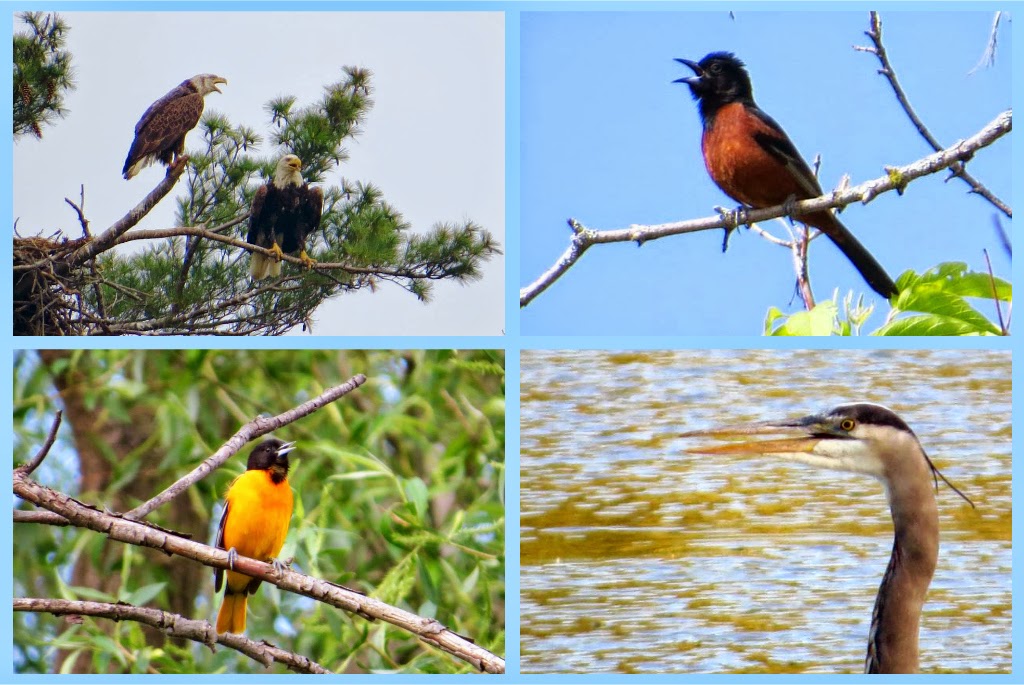
Bald Eagle, Orchard Oriole, Baltimore Oriole, Great Blue Heron

Months of bitter winter cold kept me hostage indoors earlier this year. Spring came late and then rushed by with wide temperature ranges and little rain. Forsythia and lilacs bloomed together in some areas instead of a month apart as usual. Spring birds returned in a trickle and then in a flood over the past two weeks. The forest canopy opened quickly making it hard to see some of our smallest songbirds. But the woods, marshes and meadows are alive with birdsong. I have the songs and calls of all the birds of Eastern North America on my iPod and I listen to them in the car, hoping to become familiar with more of them.

Brown Thrasher, Red-winged Blackbird (2), Norther Flicker

Songbirds learn their species' sounds in the first few days and weeks of life. Occasionally there are regional variations. Some birds have a repertoire of a couple of songs while others may have many more calls and melodies. A few birds like Mockingbirds and parrots are able to imitate sounds they hear from other birds, humans or machines. I visited a patient once who had a parrot who said hello every time the phone rang. Some birds can learn another species' song if they are adopted into that bird's nest shortly after birth. But on the whole, listening is a reliable way to identify many birds. I followed the sound of a Pine Warbler and after fifteen minutes of neck-stretching searching, found it on the top of the tallest pine tree. Birds, especially the males, are often more vocal in the spring as they establish nesting territories and go through mating rituals.

Savannah Sparrow, Rose-breasted Grosbeak, Pine Warbler, Bobolink

Like birds, humans learn language and music beginning in infancy even though words and melody activate different areas of the brain. We know that children can learn other languages without an accent if they are exposed before adulthood. I came to Canada as a school child with a strong South African accent, but it was gone in a few months. Adults hold on to an accent for life. The music styles we are exposed to when we are young tend to become our preferences for life. I do not understand eastern music with its alternate scales and tones and it would be difficult for me to learn it now. Exposure to various music styles at an early age increases our understanding and enjoyment of more genres of music as we get older.

American Goldfinch. Female Red-winged Blackbird, Yellow Warbler

Music is often at the centre of generational separation and conflict. My generation of baby boomers embraced rock and roll in the 1960's to the consternation of our parents. Rap, heavy metal, ska, and electronica appealed to our children and we didn't care for it. There are so many sub-genres of music now that our ability to sing together as a multi-generational community is greatly reduced. (country, folk and bluegrass music may be exceptions to this). My daughter and son-in-law took us to see Mozart's The Marriage of Figaro at the National Arts Centre this year. We commented on the white-haired patrons who made up the majority of the audience, just like the demographic of many churches.


These young siblings played classical selections skillfully at our local market last week. They will always understand and enjoy this music style. Why not expose children to a large musical heritage as their brains form musical memory;- ancient, classical, cultural, spiritual, modern and post-modern? They will explore the new sounds of their generation on their own but maybe we will have some songs we can sing together around a campfire or a concert we can enjoy together.

I am challenged when I try to understand and appreciate music forms outside of my experience. If I can learn new bird songs, surely I can learn some new music too.

Music isn't just for the birds.

Song Sparrow