Showing posts with label guest photographers. Show all posts
Saturday, July 30, 2011
Canadian Summer
My cousin and her family just returned from a week at a cottage near North Bay, Ontario. I love this picture and she kindly allowed me to post it here. It shows everything I enjoy during our Canadian summers...water, beautiful skies and sunsets, bonfires and good company. And the moon is just a spectacular bonus.
Friday, April 15, 2011
Competing with the Other Woman
For the past week my husband has been telling me about a female Northern Cardinal who has spent time every day trying to get rid of the competition she sees in his truck's side mirror. Neil is the co-worker who took these shots today through the office window. He posted them on Flickr and has been kind enough to let me share them as well. The vehicles are parked here every work day so I hope she finally figures out that her mirror image is not really invading her territory.
Tuesday, March 22, 2011
Beauty and the Beast
![]() |
| Vermilion Flycatcher- Tepic, Nayarit, Mexico |
My dad has shared pictures of colourful birds he has seen on their property in western Mexico over the winter. This week he sent me another beautiful photo, this time a Vermilion Flycatcher. Our flycatchers here are feathered in brown, olive and pale yellow at their brightest.
My best bird picture of the week looks sinister in comparison, but I was strangely happy to see this noisy pair on the bare branches of the tree.
![]() |
| Common Grackles- Southern Ontario, Canada |
Thursday, January 20, 2011
Birds Here, There and Everywhere
![]() |
| Great Kiskadee, Nayarit, Mexico |
![]() |
| San Lucas Robin, Nayarit |
![]() |
| White-tailed Kites in a bamboo tree |
![]() | ||||
| Hovering over a sugar cane field in Mexico |
![]() |
| Successful hunt |
All photos by David Tolman
Thursday, December 30, 2010
Early Friday Flowers and Birds of Mexico
![]() |
| Macro of wild asters |
Dad has always been interested in photography and used good SLR cameras for taking slides as we were growing up. In my opinion, he has never had a decent digital camera to match his ability as a photographer. He bought my Canon SX10 this year when I upgraded to the Canon SX30 and is having a great time taking pictures with the 20x zoom, sports mode and the macro feature. Two weeks ago I shared flower pictures he took around their home in Mexico. The honeysuckle, which is pretty much finished blooming now, attracted some beautiful birds. Here are a few pictures Dad took this month.
![]() |
| Male Altamira Oriole |
![]() |
| Female Altamira Oriole Feeding on Honeysuckle |
![]() |
| Can you see the Hummingbird? |
![]() |
| I am not sure what type of Hummingbird this is |
Camera comments...
I am still getting used to the Canon SX30 but I don't think it takes better pictures than the SX10 Dad is now using. The newer model has a 35x zoom which is fine if there is excellent light, but there have been few days this winter bright enough to use the full zoom capabilities. I am happy with its size and weight as I do not want to carry a DSLR and heavy lenses out on walks. The manual came on a CD which I find quite inconvenient so perhaps I will print it out and get better acquainted with the SX30 in the new year.
Friday, December 17, 2010
Friday Flowers: Mexico at Christmas time
![]() |
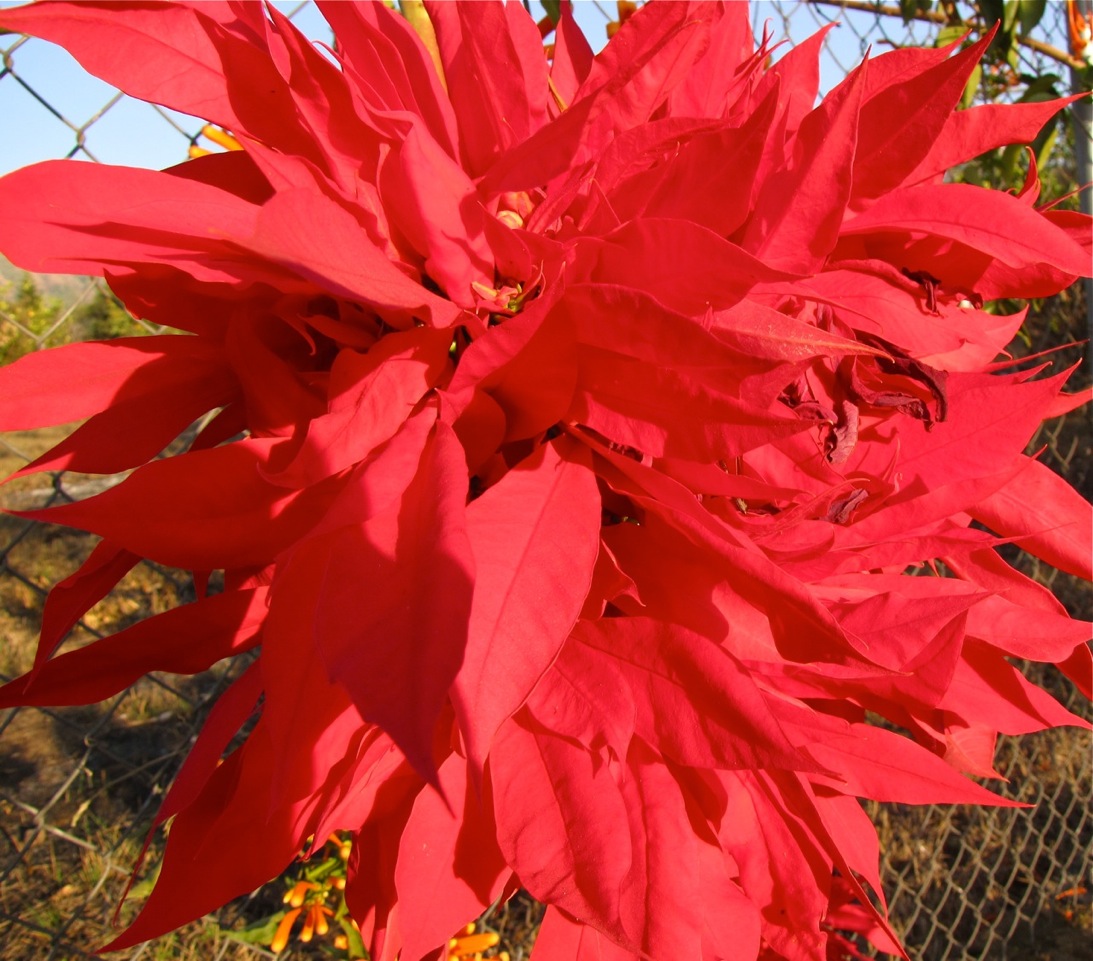
| Poinsettia in my family's yard in Tepic Mexico |
![]() |
| Honeysuckle on the fence behind the house in the late afternoon |
![]() |
| Poinsettia macro |
Sunday, August 22, 2010
Community
com·mu·ni·ty
Pronunciation: \kə-ˈmyü-nə-tē\
Function: noun
1 : a unified body of individuals: an interacting population of various kinds
of individuals in a common location
My father took a series of slides at a Mennonite barn raising in the early 1970's shortly after our family moved to Waterloo County. A fire had destroyed a barn near Elmira, Ontario and the community came together very quickly to rebuild the structure. A barn is essential for storing feed and housing livestock and is the most important building on a farm. Rural communities have come together like this for hundreds of years and the tradition in this modern era is still strong among Old Order Mennonites. Each man knows his place in the process and he volunteers his time to help his neighbour. Rubble is cleared and new supplies are ordered in a short period of time. The women serve food and the children help where they can as they observe their community working at its best.Function: noun
1 : a unified body of individuals: an interacting population of various kinds
of individuals in a common location
Photo courtesy of Andre Secours
I took these pictures just 12 days after the fire and the new barn was already erected. The burned rubble was gone, the painting was almost completed and windows were being installed.
I like the definition of 'community' at the beginning of this post. Individuality does not need to be lost, but people interact in a unified way. While most of us would not want to give up modern conveniences and live like Old Order Mennonites, many people admire the strength of their community. We all need to belong to a group and traditional groupings in our modern society are increasingly fragmented. I see few of my neighbours on the street where I have lived for over 30 years and we go our separate ways each day. Family groups are separated by distance, broken relationships and the failure to make efforts to keep in contact. Many young adults are not finding a place to belong in church congregations and generational segregation in many religious institutions is formidable. Facebook and Twitter friends do not make a community that can substitute for real belonging.
We all need somebody to lean on...
Wednesday, December 16, 2009
Remember Whensday: Ice Skating

This is probably the only picture I have of myself wearing ice skates. The year was 1963 and my dad and Sandland brother were with me outside our home in Aurora, Ontario. Dad is wearing a sweater knitted by Marie, a lady who lived with my grandmother for many years. I don't recall where we skated or if we had a backyard rink that year. I know we were not at an indoor arena.
I never was a good skater, in fact you could call me a terrible ice skater. Much as I love the outdoors and walking, sports were never my forte. The only way I could stop on skates was by running into boards or a snowbank. And I was even worse on roller skates! My husband is a very good skater and still plays hockey three times a week. When our girls were small, I took them skating at a local rink every week and managed to stay on my feet while pushing a stroller in front of me. I was looking at my old battered skates a while ago and knew it was time to get rid of them for good as I do not see myself venturing out on ice for fun again.
Sandland Brother is with our next oldest brother in the picture below at a farm where we attended many winter parties. These two brothers played more football than hockey in their youth and were very athletic. We took a few swimming lessons, but did not participate in organized sports outside of school. These days children have more opportunities to take classes to improve their skills in a variety of sports.
We have several outdoor rinks in the city where we now live and I enjoy watching youngsters as they learn to balance on their blades. Do you ice skate or roller skate??

Follow this link for more Remember Whensday posts.
Thursday, December 10, 2009
Brrrrr...from West to East
One of our daughters took a spur of the moment road trip to Chicago this past weekend with a friend. Chicago is a good seven to eight hour drive west of here on good roads if the weather is fine. We had an exceptionally warm November and until yesterday had no measurable snowfall in our area. But when we hear of storms and cold weather west of us, we know our turn is coming soon. One of our most frequent winter storms is called an Alberta clipper, or Canadian clipper south of the border. These fast moving low pressure systems move from the west between December and February and often pick up moisture as they pass over the Great Lakes. I don't know if the storm this week was a clipper, but we received a nasty mixture of snow, freezing rain and rain and now the temperatures are dropping as winds bring heavy snow flurries off Lake Huron.
These pigeons were huddled around a flame in downtown Chicago a couple of days ago. Eldest daughter called them "pigeons roasting by an open fire, (Jack Frost nipping at your nose)..." I don't know of any similar warming fires in our city and the birds will be roosting in protected areas tonight.

I have never been to Chicago and thought it was just another big industrialized city without a lot of tourist appeal. But it looks like an interesting place to visit, especially in December. Their Christkindl Market runs through the month and looks very similar but larger than our local four day Christmas market.
Winter has arrived...
These pigeons were huddled around a flame in downtown Chicago a couple of days ago. Eldest daughter called them "pigeons roasting by an open fire, (Jack Frost nipping at your nose)..." I don't know of any similar warming fires in our city and the birds will be roosting in protected areas tonight.

I have never been to Chicago and thought it was just another big industrialized city without a lot of tourist appeal. But it looks like an interesting place to visit, especially in December. Their Christkindl Market runs through the month and looks very similar but larger than our local four day Christmas market.
Winter has arrived...
Tuesday, November 17, 2009
Red-tailed Hawk Rescue

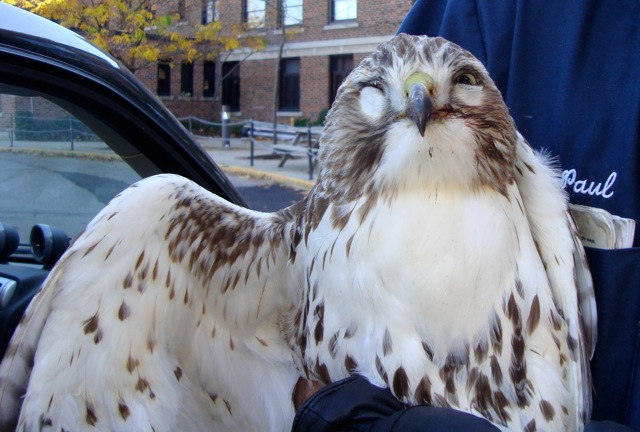
Paul is the plumber at our hospital. I knew him as the person who had a Smart car in the parking lot, but recently found that he also has a keen interest in the natural world around him. On his way to work last week he noticed a young Red-tailed Hawk lying at the side of the expressway which runs through our twin cities. He thought it was dead but stopped, picked it up and continued on his way to work.
Deb* works at the reception desk but is more at home with her camera taking pictures of birds and wildlife. She is one of those people who brings her camera everywhere she goes just in case she has a great photo opportunity. The hawk was very docile and allowed Paul to handle it while Deb took these pictures. Sadly, I had already left work for the day.
The hawk was alive but sustained an injury to its right eye and had some bleeding from its beak. Apparently it was able to move both wings normally and had no other obvious external problems. Paul called the local Humane Society and they arranged to have the bird moved to Hawkeye, a regional bird control and rehabilitation facility. The plan was to return the hawk to the area where it had been found once it was well enough to be released.
On Friday Paul heard that the bird was recovering but today he came and told me that it had died from its injuries. We have many Red-tailed Hawks in our area and they are seen frequently in the city, often on light standards along busy roads. I drive the same expressway home and recognize the "golf course" hawk and the pair of "land fill" hawks who are seen in basically the same area each day. Large birds which hunt near traffic are at risk for injury from cars and trucks. This hawk must have had injuries more severe than were initially apparent.
Man made structures and machines inadvertently injure and kill many birds each year. But people like Paul, the staff at the Humane Society and Hawkeye do what they can to save unfortunate victims. Hawkeye claims that about 70% of the birds in their care survive. It is too bad that this hawk was not one of them.
*All photos taken by Deb Lehman. Please do not copy or reproduce
Wednesday, September 16, 2009
Remember Whensday: By the Water
I have no memory of this day in 1959 when my father took the picture of my brother and I at the Thousand Islands in Ontario, Canada just before we returned to South Africa. We were at a picnic with other members of our extended family and wore matching outfits undoubtedly sewn by our mother.
Childhood memories may be foggy but impressions, pleasures and fears are often grounded in these early experiences. To this day, I love being on the shore of a body of water, be it a river, lake or ocean. I am not as fond of being in a ship far away from land and have never been interested in taking a cruise vacation.

Here we are about a year later having another picnic at a man-made lake in South Africa. Nagle Dam is in the Valley of the Thousand Hills not far from Durban. We were not allowed to play in the water here for fear of contracting bilharzia from fresh water snails found in the area. That is something I do remember well.
Toronto, Ontario 2008Time has passed and this brother now lives thousands of miles away. He came to Canada for a visit last summer and we walked along the shore of Lake Ontario in Toronto before I took him back to the airport. The Becka took this picture, unknown to us, and I posted it last year. Isn't it funny how I always stand on his right when we look out at the water? Two of my sister-in-laws pointed out the similarities I failed to notice in these pictures.
We have lived apart far longer than we lived at home together, but forty-nine years later, some things remain unchanged.
Wednesday, September 09, 2009
Remember Whensday: Apple Season
My mother's parents purchased land about five miles from their small home town and planted many trees in the sandy soil. My grandfather grew up in the Thornbury, Ontario area which is still well known for its apple orchards. He planted a large apple orchard at the farm with a good variety of heritage apples. I knew the difference between Snows, Wealthys, Macintosh, Tolman Sweets, Cortlands and Spy apples when I was still a child. Granddad died well before I was born and my uncle managed the farm for many years. Each fall we spent weekends picking apples for Uncle Bill and were paid by the bushel for our labours. Afterward, we collected "grounders" which we took home free of charge. I loved those fall weekends when the air was fresh, the trees were turning colour, and the milkweed pods were dry and silky.
The farm was large and we had time to explore the lower pasture, the pines and the pond on the other side of the large barn. There were swings and a one room cabin with a screened in porch where we could eat our lunch. Our water was pumped from a well which had an green wooden handle and the facilities consisted of a single seater out house.
There was an old cider press near the water pump where we could make some freshly squeezed apple juice. It would become fermented very quickly as it was not pasteurized.
Apples remain my favourite fruit and I look forward to tasting my first crisp fall apple each year. Mom always had a very large bowl of applesauce on the counter and we ate it for dessert most nights. Sometimes we had it with fresh gingerbread and often with fresh muffins.
I bought some new apples at the market last weekend and they should be coming to their peak by the end of the month. And I will make applesauce and apple crisp and all kinds of other apple recipes. But nothing beats a fresh apple just picked from the tree, juicy, sweet and delicious!
(My cousins still run the farm and here is a link to their website)
Sunday, September 06, 2009
Blue Jays Bold and Bald

Last month I mentioned the trio of Blue Jays who were stopping by our yard for peanuts. At that time they were very skittish and would vanish quickly if I stepped outdoors. In recent days they have become much more assertive and call for their treats if the peanut feeder is empty. As soon as they hear someone in the kitchen through the open window, they will give one of their more gentle and musical calls from the deck screen or lilac bush. They know I will be out with peanuts and now wait and watch as I place them on the picnic table. While they are unlikely to ever eat from my hand, they will now come down to the table when I am still on the deck.
Two of the Blue Jays have a normal appearance, but the third is greatly altered lately. I took a photo early one morning as the sun was just coming up which showed its bald, featherless head and neck. It is able to fly normally and seems otherwise fit and healthy. Here is an explanation from Bird Studies Canada. I have copied the information as links tend to go dead quickly.
At Bird Studies Canada, one of the signs of changing seasons is the type of bird questions we get from our members and the public. Recently, we have been receiving concerned calls about follically-challenged birds. While most of the calls are about Blue Jays, other baldies include Northern Cardinal, Common Grackle, and various sparrows.
So what's up with these bald birds? Several explanations have been proposed, with the two main ones being a severe case of feather mites and an unusual moult pattern. Wild birds normally carry small numbers of feather mites - tiny arthropods (related to ticks and spiders) specialized to feed on bird feathers. Birds must regularly groom their feathers to remove these mites and other parasites. While birds can groom most feathers with their bills, they can't reach their head feathers. Mite populations on head feathers can build up to the point where the feather is totally destroyed and/or has been pulled out by the bird scratching at its head.
This "follically challenged" Jay comes very early in the morning or at dusk and is seldom seen with the other two right now. It must be somewhat self conscious about its appearance.

Dennis and Shirley are friends who live nearby and attend our church. They have been visited by a particularly bold Blue Jay this summer who knocks on the window and then comes into their living room to take peanuts from the carpet. Dennis sent me this photograph which he took a few weeks ago.
Now that is one well trained Blue Jay, or one well trained human couple depending on your perspective!
Wednesday, June 17, 2009
June Babies: Owls and More at the Swamp
Swamp at Huron Natural AreaI returned early the next morning before work (this time with bug repellent) and saw the same owl in a pine tree much closer to my seat. For such a large bird, it was well camouflaged in the tree as it sat motionless for over an hour. When I looked at my pictures later it seemed that the bird spent much of its time with its large eyes closed. Babies do need lots of sleep. Just as I was leaving, a group of crows started harassing the young owl and it flew deeper into the bush.
The swamp was alive with more than mosquitoes and from my log I watched a Great Crested Flycatcher, a Belted Kingfisher and two Great Blue Herons as they looked for food. Directly across from me a pair of House Wrens brought a succession of bugs to their nest in a dead stump. They would sing loudly from a branch when they were not feeding the young wrens.
This past Sunday a couple of friends were sitting at the same location early in the morning when a young coyote stepped out of the rushes. They reported that some emergency vehicles drove on a nearby road with sirens on, (this is an industrial/residential zone of the city) and the swamp came alive with the howls of several invisible coyotes. I hoped to see a young coyote when I came early in the morning but was not lucky enough to have one come out in the open even though I could hear movement in the area. Andre has kindly allowed me to post this picture he took of the pup which looks very healthy and inquisitive.
Coyote Pup (Andre Secours)
Subscribe to:
Posts (Atom)